
 AUS
AUS
 NZ
NZ
 UK
UK
 CA
CA
 USA
USA
 IND
IND





Summary
- British Prime Minister Boris Johnson announced the second national lockdown to be imposed from 5 November to 2 December amid rising coronavirus cases.
- Two of the most affected sectors are the hospitality and retail sectors, which are already suffering considerable damage during the first lockdown.
- The new lockdown has come at a worse time especially for the hospitality and retail sectors, which usually see a spike in business in November and December.
The recent announcement of the second lockdown in the country has brought back the threat of a double dip recession. Most businesses in the country, which had barely recovered out of the adverse effects of the first lockdown, will now have to deal with this second blow. The four-week shutdown will surely take out a considerable chunk out of GDP because the sectors, retail, hospitality, travel, tourism – which make up around 15 per cent of the total economic activity, are expected to be the hardest hit.
Nevertheless, the sectors which have witnessed a strong recovery early on after the first unlocking will be relatively less impacted compared to the industries which have started their recovery process late.
The worst effect of the pandemic, however, will come on the state of unemployment in the country which is already at an alarming level. Though there is a silver lining amid all this pandemonium. The government is scheduled to make a running review of the AstraZeneca vaccine within a few days, which will give strong hopes that the vaccination process would start before the year-end.
The lockdown
On 1 November, PM Boris Johnson declared that the second lockdown would be implemented from 5 November to 2 December. This lockdown, however, will be a little less stringent than the first lockdown as several activities won't be restricted as before. Schools, nurseries, playgrounds and universities shall remain open along with factories, construction sites and farms will be allowed to run. People will be allowed to leave home for essential work and for some leisure time like visits to parks.
Establishment that will be impacted will be the retail outlets, restaurants and pubs apart from takeaways. The government has also banned all inbound and outbound international travel for this phase of the lockdown except for the essential ones.
Impact on hospitality
The government has specifically put restrictions on the restaurants, hotels, pubs, and other such establishments belonging to the hospitality sector for the lockdown.
The sector which also saw such harsh restrictions being imposed during the first phase has been witnessing a slower recovery that many other sectors. The sector employs a significant number of unskilled and semi-skilled labour who would now face an elongated period of unemployment.
There are also several other sectors like food and beverages and tourism that are indirectly dependent on the hospitality sector who would be facing a fall in business activity levels because of this lockdown.
Impact on retail
The retail sector was another sector which had witnessed widespread damage during the first phase of the lockdown.
Ever since the lockdown was imposed, several retail companies in the country went under lockdown and many others have scaled back their operations.
The online retailing segment of this industry, however, saw considerable success during this period. When most people during the first lockdown were forced to stay indoors, they only had online delivery of goods at their doorsteps as the only alternative to keep themselves provisioned during the lockdown.
This sudden increased increase in online retailing transactions in the country resulted in massive growth in this segment of the industry in a few months that had not been witnessed in years.
This time around, however, things may not be as bad for the traditional shopfloor retailing as people are being allowed to go out of their homes for essentials. Supermarkets and neighborhood retail stores thus expect a steady flow of customers. Online retailing of goods as a percentage of total retailing which peaked out during July and then had come down, can be expected to hit a second peak before the end of the year.
Now, let us scan through the performance of two firms from the affected sectors.
Whitbread plc
Whitbread Plc (LON:WTB) is a UK-based hospitality company which owns and operates hotels and restaurants in the country and several foreign locations.
On 27 October, the company came out with its interim results for the year, where it reported a performance that was better than street expectations. The company has also grown organically by increasing its footprint to 21 venues across Germany. The CEO at the time of results stated that they had been able to improve their flexibility to respond to change in demand, which has given then a strong foothold to deal with the second lockdown.
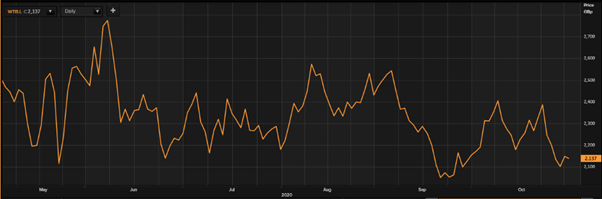
Source- Thomson Reuters (six- months performance)
As on 2 November, the shares of Whitbread plc have been trading at GBX 2,142.00 per share (10.22 AM GMT+1) losing 0.23 per cent over the previous day’s close.
Marks & Spencer Group plc
Mark & Spencer Group plc (LON:MKS) is one the UK domiciled multinational retailing company and one of the country’s most popular brands. The company retails clothing, home products and food products.
Last year in February, M&S had paired up with Ocado group plc to form a joint venture called Ocado Retail Ltd, after the former acquired 50 per cent stake in the company for £750 million. The venture has been receiving phenomenal response since its launch day on 1 September.
The JV allows M&S to sell its branded grocery products through Ocado’s online platform will continue to perform well even through the second lockdown.
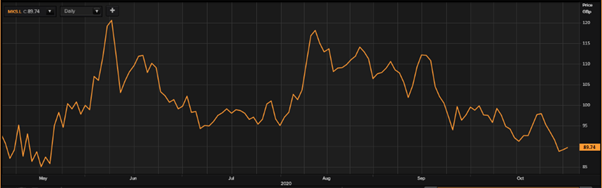
Source- Thomson Reuters (Six- months performance)
As on 2 November, the shares of Marks & Spencer Group plc have been trading at GBX 90.44 per share (10.24 AM GMT+1) gaining 1.46 per cent over the previous day’s close.
