
 AUS
AUS
 NZ
NZ
 UK
UK
 CA
CA
 USA
USA
 IND
IND

_07_03_2026_03_50_21_133108.jpg)



Summary
- Aston Martin has announced a refinancing package worth £3 billion, with Mercedes- AMG increasing its stake to 20 per cent in the firm
- The refinancing package comprises debt and equity and will also see Mercedes- AMG handing out £286 million worth of electric vehicle technology to Aston Martin
- The largest part of the refinancing package is a £2 billion worth of debt issuance, which helps Aston Martin to increase its cash balances to more than £500 million
British luxury sports car manufacturer Aston Martin has managed a pact along with its owners, associates, and investment firms to get a refinance deal worth £1.3 billion. The deal, which will see about 20 per cent of the company’s shareholdings going into the hands of Mercedes- AMG, will also bring in £286 million worth of electric vehicle technology know-how.
The company, which had made some big investment into the EV technology segment in 2018 and 2019 to stay competitive in fast-evolving internal combustion to electric traction vehicles, became one of the principal reasons for its current dilapidated financial affair.
The current refinancing deal will not only help the company to sail through the ongoing coronavirus induced market conditions but will also infuse fresh life into its near-complete projects which have the potential to take the company to new heights.
Refinance deal
In the refinance package, the largest is the debt component worth £1.2 billion which will help it to refinance its old debts and will also bring in extra money to its cash registers helping it with its working capital requirements.
The package includes a pledge from Mercedes- AMG to provide the company with much-needed electric vehicle technology worth £286 million which will help the firm to turn out electric cars by 2026. In return, the Mercedes- AMG will not only expand its partnership with Aston Martin but will also pick up a 20 per cent stake in the company.
The deal also includes fresh investments of £125 million from hedge fund Permian Investment Partners, Zelon Holdings (an investment office of an unnamed European Family) and Lawrence Stroll, who is the executive chairman at Aston Martin. Incidentally, Laurence Stroll had bailed out the Aston Martin in January this year by infusing nearly £500 million and had taken up his current position in the company.
Aston Martin
The company came out with its financial results for the first half of the year on 29 July 2020.
The company’s total revenue for the first half of the year was £146 million, whereas, for the corresponding period the previous year, the revenue stood at £406 million, thus registering a fall of 41 per cent this year.
The company's adjusted EBITDA for the period stood at -£89 million, while in the first half of 2019, the company had generated an adjusted EBITDA of £20.8 million. Its adjusted operating loss for the period stood at £145.5 million, whereas in H1 2019, the company had incurred an adjusted operating loss of £36.4 million.
The company’s operating loss for the period stood at £159.0 million, while for the corresponding period in 2019, the company had incurred an operating loss of £38.9 million. The loss before tax of the company for the first half of 2020 stood at £227.4 million whereas, in the first half of 2019, the loss before tax of the firm stood at £80.0 million.
The net debt in the books of the company as on 30 June 2020 stood at £751.00 million, down from £843.6 million standing on 30 June 2019.
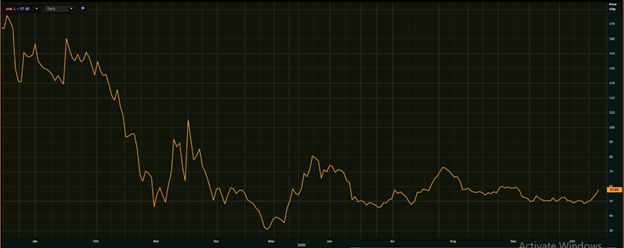
Share price performance of Aston Martin Lagonda Holdings plc
Aston Martin Lagonda Global Holdings PLC (LON:AML) is a Warwick, United Kingdom-headquartered prominent luxury brand that is focused on the engineering, manufacturing, and design of luxury sports cars.
(Source- Thomson Reuters)
As on 28 October 2020, the share of Aston Martin Lagonda Holdings plc was trading at GBX 57.60 (11.52 AM GMT+1), gaining 5.63 per cent over the previous day’s close.
UK car industry
The sales of new cars in the UK in September has been the weakest in 21 years. The month, which historically has seen bumper sales, saw very poor sales this year as consumers remained cautious about making any large spending. Compared to September last year, the sales this year were lower by 4.4 per cent, with 328,041 vehicles being sold.
It is to be noted that the car industry has not only been negatively impacted by the coronavirus pandemic but also because of the rapid transition in the marketplace which is increasingly preferring electric vehicles on increased environmental regulations over petrol and diesel vehicles, which have been gradually lowering their availability and sales.
Over the past couple of years, the UK has been aggressively promoting electric vehicles to deliver on its commitment to lower the country’s overall carbon footprint. The regulatory measures and emission standards that have been put in place have pushed out several popular models from the market and have made the rest very expensive.
Other than that, the general population has also been very receptive to electric vehicles in the country, as their numbers have been increasing exponentially. The investment made by Aston Martin in electrical vehicle development was thus critical to maintaining its competitive position. The current refinance package and technology know-how transfer from Mercedes- AMG will help it protect and derive value out of its past investments.
