
 AUS
AUS
 NZ
NZ
 UK
UK
 CA
CA
 USA
USA
 IND
IND

_07_03_2026_03_50_21_133108.jpg)



Summary
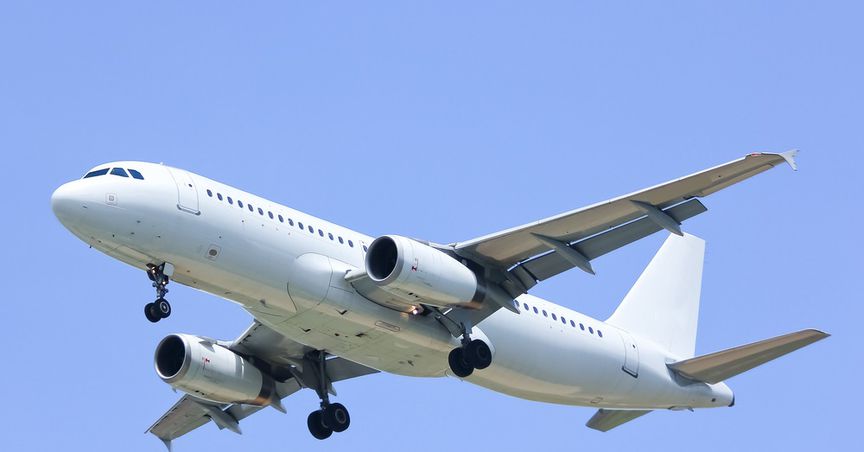
- Airbus has announced that it will slash its workforce by 15,000 worldwide, except its core locations in Europe.
- The Aircraft manufacturing major has sighted the slower than expected recovery in the global aviation market, which has necessitated the company to cut costs.
- Recently the company had announced the launch of three new Hydrogen-powered aircraft which it believes will reduce the cost and carbon footprint of the global aviation industry.
Europe's largest Aircraft manufacturer Airbus has stated that the aviation industry is feeling the heat of the coronavirus pandemic on its bottom lines. The company has made an announcement this week that they would be going ahead with their plans to make 15,000 of their positions redundant, following a slower than expected recovery of the global airline industry. The company which has operations in all major markets of the world is expected to slash jobs in its non-core locations and protect jobs in Germany and other key locations in Europe where the majority of its manufacturing facilities are located.
It is worth noting here that the order inflow has declined for the company while existing customers are slowing down on taking deliveries. The entire aviation sector and its related sector across the world are in dire straits as people are avoiding air travel due to the continuing threat of the pandemic. Europe, where the pandemic has slowed down significantly after a rapid growth was seen in the months of March, is still waiting for the vaccines to hit the market and mass vaccination starts.
The operating environment for Airbus and related industries
The main lines of business for Airbus is the manufacturing of Aircraft, and the other one is their maintenance and supply of spare parts. During the pandemic, both of these market segments for the company have deteriorated. Most airline companies bottom lines are now suffering because of the pandemic and are either cancelling or postponing any planned capital expenditure decisions, which is the reason why order flow of the company has slowed down, and existing orders are not being picked up as per schedule. On the maintenance and spare parts supply verticals, the business slowed down because most of the aircraft around the world are grounded requiring little maintenance to keep them flying ready. Thus the company’s business locations outside of Europe, which are directed more towards assisting existing clients have been witnessing very low business activities, and staff members are remaining unproductive for long periods of time. On the other hand, the company is continuing to spend on research and development and only last week announced the launch of three futuristic Hydrogen fueled concept aircraft.
There is also the consideration of employee safety that the company has to keep in mind while deciding to keep any of their locations open. In core locations in Europe where manufacturing activities take place the company has adopted measures to safeguard its employees but in far off locations where there are only employees the cost and risk of an employee are much higher.
The fourth-quarter 2020 outlook for the airline industry
The fourth quarter of 2020 is expected to bring about a slower than expected recovery in the airline market. While in Australia, Asia and even in the Americas the pandemic has significantly slowed down, the spike in infection rates in being observed in important countries like the UK and France. Since these markets account for a major portion of the global aviation industry, they will have a defining impact on the rate of recovery in the airline markets. Airline companies belonging to these countries will continue to trade weaker until the situation on the pandemic starts to improve again, while airlines belonging to other countries could see their situations improving. The maintenance and spare parts markets will see a steady recovery as the non- European markets will continue to recover, resulting inflow of orders for these components and services. However, the situation in the market will improve greatly after an effective vaccine is made widely available. People, them will feel more confident, to come to airports and fly and will be less afraid of catching the infection. However, it is highly unlikely to happen before the end of this year.
The effect of the deteriorating market conditions on IAG, EasyJet, and Wizz Air
Since the news of a spike in the infection rates in the UK started to flow in, and new restrictions were imposed by the government, important British airline stocks started to underperform on the London Stock Exchange.
International consolidated Airlines Group SA (LON:IAG)
(Source – Thomson Reuters)
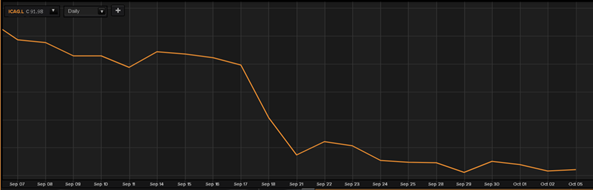
The share prices of IAG peaked during the mid of September before climbing down again as the pandemic situation started to deteriorate. As on 6 October 2020, the shares of the company were trading at GBX 94.10 per share at GMT+1 9:52 AM, gaining 2.80 per cent over previous day’s close.
EasyJet Plc (LON:EZJ)
(Source- Thomson Reuters)
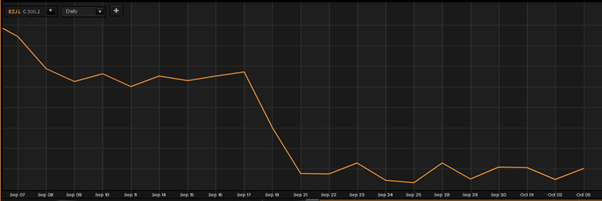
The stocks of EasyJet Plc have performed poorly over the last one month. The stocks saw a sharp fall between 17th and 21st of September when the news of enhanced pandemic related restrictions started to trickle in. On 6 October 2020, the stocks of the company were trading at GBX 519.00 per share at GMT+1 9:53 AM, gaining 3.76 per cent over previous day’s close.
Wizz Air Holdings Plc (LON:WIZZ)
Source- Thomson Reuters
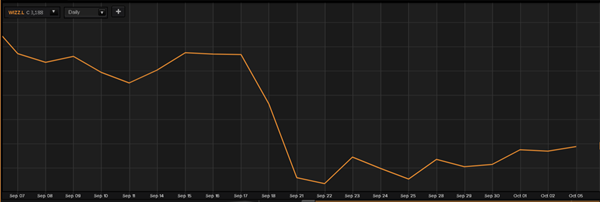
Wizz Air Holdings Plc has also not been performing well on the London Stock Exchange over the past one month. The shares of the company also fell sharply between the intervening period of 17th and 22nd of September when new restrictions were imposed due to spike in infection rates. The shares of the company were trading at GBX 3,262.00 per share at GMT+1 9:55 AM, gaining 2.32 per cent over previous day’s close.
Outlook
The situation in the airline industry would continue to see volatility until the end of this year as respective governments in the European region continue their efforts to contain the pandemic. Both the airline and the aircraft manufacturing industries in Europe would require continued government support for an extended period of time.
