
 AUS
AUS
 NZ
NZ
 UK
UK
 CA
CA
 USA
USA
 IND
IND






Summary
- In the last two days, the stock markets have been largely skewed by the day-to-day progress in the US presidential election
- The FTSE 100 has consolidated the gains in the last two sessions with an upswing of nearly 4 per cent
UK stock markets have remained extremely volatile in 2020 over a number of issues ranging from the outbreak of coronavirus cases, Brexit deal and trade talks, outwardly extended trade tussle between the US and China and the aftermath of the pandemic, lockdown on the businesses.
In the last quarter of this year, the result of the United States presidential elections seemed to have taken the charge of market direction across the world. The dollar slid and global equity markets jumped on Tuesday as bets on Joe Biden’s win against President Donald Trump are rising.
Recent impression of US presidential election
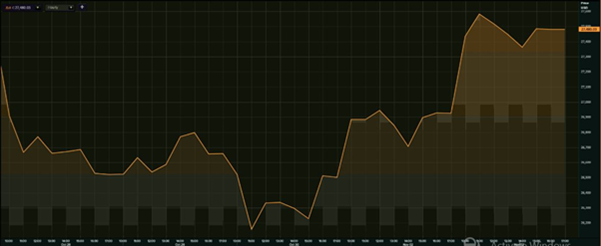
In the last two days, the stock markets have been largely skewed by the day-to-day progress in the US presidential election with the NYSE-controlled US benchmark index Dow Jones Industrial Average (DJIA) rallying as much as 978.43 points or 3.69 per cent to 27,480.03 from a level of 26,501.60.
DJIA (1-week performance)
(Source: Thomson Reuters)
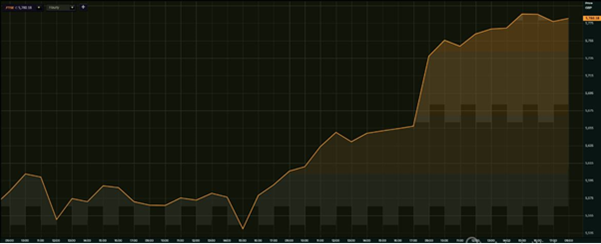
The global markets have depicted a typically similar gain tracking the sharp uptick in the US indices. The Dow Jones Industrial Average saw a 2.17% rise, while the S&P 500 gained 1.99% and the Nasdaq Composite added 1.92%. The FTSE 100 has also consolidated the gains in the last two days with an upswing of nearly 4 per cent. The headline FTSE 100 index has accumulated 209.50 points or 3.76 per cent to 5,786.77 in the last two days from a level of 5,577.27 as on 30 October.
FTSE 100 (1-week performance)
(Source: Thomson Reuters)
Other major stock indices that have followed the suit in the previous two trading sessions include Germany’s DAX (up 4.61 per cent); France’s CAC 40 (up 4.60 per cent); Japan’s Nikkei 225 (3.13 per cent); Australia’s S&P/ASX 200 (2.3 per cent); China’s Shanghai Composite (up 1.62 per cent); Hong Kong’s Hang Seng (up 3.45 per cent); India’s Nifty 50 (up 1.5 per cent) and South Korea’s Kospi (3.36 per cent).
Impact on UK stock markets
There will be a considerable impact of the US presidential election result on the UK stock markets as the winner will provide an idea of administrative decisions taken at the White House.
A further clarity on the retaliatory trade tariffs between the United States and China can be achieved after the US presidential elections. An additional transparency on the response to the eruption of Covid-19 and announcement of fiscal stimulus going ahead can play a vital role in charting the market direction in the near future.
A sustained rally on Wall Street following the announcement of a clear winner in the US presidential elections can be momentarily perceived as a positive factor for the equity markets across the globe.
The optimism may persist for a week or a two as the pandemic-laden distress weighing on the markets can’t be whitewashed until and unless there is material development with regard to a WHO-certified anti-dote or a vaccine of Covid-19 virus.
However, it is quite hard to ascertain any concrete impact of the US presidential election results on the UK markets as there are definitive domestic factors that can add a uniqueness in the market direction including the outcome Bank of England’s Monetary Policy Committee meeting due on 5 November, the terminal talks with regard to the trade deal between the EU and the UK and the announcement of upcoming policies & relief measures to safeguard the middle-income earners.
Also Read: Volatility In Gold And Crude Surges On The Heels Of US Presidential Elections 2020
The cloud of uncertainty
However, the futures tied to the broader US stock index S&P 500 slipped in the early morning deals on Wednesday as the results of US presidential elections progressed ahead without a clear winner so far.
According to the Associated Press data, Joe Biden of Democratic Party has won 238 congressional seats, while Trump has grabbed 213 congressional constituencies. With the vote counting underway, a mark of 270 is mandatory to announce a clear winner of the US presidential elections.
In the past, when Trump and Democrat Hilary Clinton contested in 2016, S&P500 fell 1.11 per cent in a month to November 8 and slightly rebounded by 5 per cent in December. Before that during Democrat Barack Obama and Republican Matt Romney face-off in 2012, S&P500 fell 1.89 per cent in a month to election and another 1.01 per cent the next month. Obama got re-elected that year for the second term.
