
 AUS
AUS
 NZ
NZ
 UK
UK
 CA
CA
 USA
USA
 IND
IND







Summary
- France, the Netherlands, and Denmark have demanded tougher regulations on the UK mainly over the fishing rights as the EU and the UK hold talks for a post-Brexit trade deal
- The blue-chip stock index of the UK seems to be treading vigilantly fearing a no-deal situation, market experts feel
The FTSE 100 index had been on a rally over the last one week. However, it was treading cautiously on December 7 as the final round of Brexit negotiations between the EU and the UK resumed to give a final push to the trade deal. Market experts said that the premium index’s movement over the last few days probably implied that investors believed that the negotiators would somehow be pulling out a last-minute miracle.
But recently, the market felt some jitters after France threatened to veto the post-Brexit trade deal over the access to UK waters.

(Source -EODHD/Others Thomson Reuters)
Both the FTSE 100 index and the FTSE Eurotop 100 have been on a rally for the last seven days, but as the talks started on Sunday and as France threatened to use their veto, both indices have taken a minor dip before pulling back again.
Over the past five days, the FTSE 100 index has given a return of 4.24 per cent compared to the FTSE Eurotop 100 index which provided a return of 1.08 per cent. On Monday since the market opened, the FTSE 100 index was trading at a value of GBX 6,558.18, gaining merely 0.12 per cent over the previous day’s close.
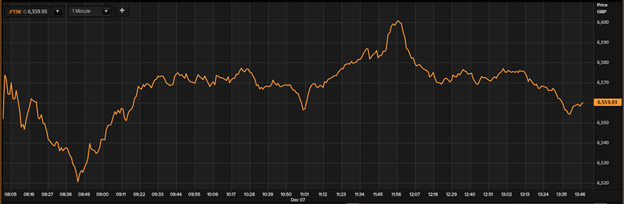
(Source -EODHD/Others Thomson Reuters) (One day trade)
French angle to Brexit deal
On December 4, France threatened to use its veto power at the EU to thwart the Brexit deal if an appropriate arrangement disregarded its economic interests. Accusing EU top negotiator Michel Barnier of being soft on the UK, France along with the Netherlands and Denmark has called for tougher regulations on the UK, especially for the fishing rights.
The post-Brexit deal will go through a close review by the remaining 27 EU countries in a meeting scheduled for 10 December.
At loggerheads
One of the biggest points of contentions between the two parties is the access to UK waters. The EU has said that it wants access to UK waters for its fleets or else it won’t allow UK fishermen to access EU markets to sell their goods. On its part, the UK has said that it wants full control on its own waters as a sovereign country.
The two parties are also fighting over a set of shared rules and standards so that none of the parties can take advantage of other competitors.
While Brussels wants that the UK should agree to the standard EU rules on workers' rights, environmental regulations and state aid, the UK has argued that leaving the EU meant not agreeing or following common rules.
Brexit impact on businesses
A successful agreement of the Brexit deal is of extreme importance to businesses on both the sides. It would essentially prevent the expiry of the EU common area regulation on 31 December. During the 47-year period, both sides had developed deep trading relations and have many businesses and sectors which are interdependent. When both sides part ways and new tariffs are imposed, businesses would lose their competitive edge, leading to some sort of loss in the near future.
