
 AUS
AUS
 NZ
NZ
 UK
UK
 CA
CA
 USA
USA
 IND
IND






Source: Gsign76, Shutterstock
Summary
- FTSE 100 fell substantially as Chancellor Rishi Sunak unravelled the Budget 2021
- The index dropped more than 1 per cent from day’s high in the afternoon session
- Meanwhile, GBP vs USD pair traded largely unchanged, with a unit of sterling equalling 1.3957 USD
The benchmark FTSE 100 seemed to have snubbed the proposals made by the Chancellor of the Exchequer Rishi Sunak in the Budget 2021 as the index slipped more than 1 per cent from the intraday high. On the contrary, the broader mid-cap index FTSE 250 remained largely unaffected.
Other wider share barometers, including the FTSE 350 and FTSE All-Share pared the gains in a largely similar manner as the FTSE 100 did, primarily due to the inclusiveness of large-cap shares in the former indices.
FTSE 100 flips from day’s top
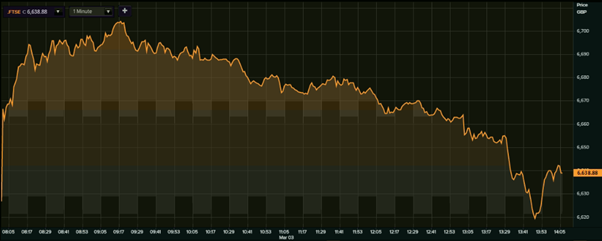
As per the latest trading data, FTSE 100 dropped as much as 1.36 per cent to an intraday bottom of 6,613.75, soon after the Chancellor ended his Budget speech, from a day’s peak of 6,705.30. At around 1405 GMT, the FTSE 100 was trading at 6,639.55, up 0.39 per cent from the previous close of 6,613.75.
FTSE 100 (3 March - Budget 2021)
(Source: EODHD/Others, Thomson Reuters)
The index progressed ahead on a higher note, gaining more than a per cent from the previous close, but failed to maintain the uptick as Sunak untangled the offerings of the Budget 2021.
Ballooning deficit batters sentiment
With more than a year into coronavirus, the government intended to engulf multiple sectors through various monetary allocations and supplementing of some presently-running schemes, including the extension of ‘furlough scheme until September 2021’ and ‘reduced VAT rate for tourism and hospitality sector’.
However, the worries of rising budget deficit unnerved the market participants, renewed the fears of volatility as the country has to splurge money to sustain and expand the ongoing roll-out of vaccines and other healthcare requirements. The budget deficit of the UK has widened to a new record high of £355 billion, nearly equivalent to 16.9 per cent of the gross domestic product (GDP).
How markets fared from Budget 2020 to Budget 2021
Earlier last year, the benchmark FTSE 100 suffered a fall of 1.40 per cent on Budget day, while a massive crash of 10.87 per cent was observed on the following day after the repercussions of the coronavirus pandemic began to emerge. The expected aftermath of Covid-19 pandemic, at that time, distressed the industry bodies and businesses of every scale and size.
The fears of a global recession, job losses, bankruptcies, business closures and large-scale depletion of profits instigated bizarre worries amidst the policymakers, market participants, as well as the common people. With more than a year into the coronavirus pandemic, the markets have partially regained their lost momentum.
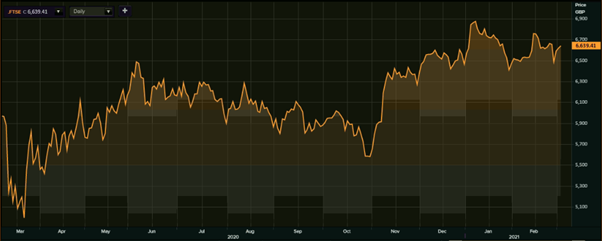
FTSE from Budget 2020 to Budget 2021
(Source: EODHD/Others, Thomson Reuters)
According to the historical data available with the London Stock Exchange, the FTSE 100 has amassed a gain of more than 12 per cent, barring the present day surge, from the closing on the previous Budget day, 11 March 2020. The index has moved to 6,613.75 from a level of 5,876.52.
In the corresponding stretch from Budget 2020 to Budget 2021, FTSE 100 has registered many sessions in which extremely wild moves were seen. Some of the major corrections include the 10.87 per cent drop on 12 March, 5.25 per cent crash on 27 March, around 4 per cent fall each on 16 and 18 March and 11 June, respectively.
On 16 March, FTSE 100 recorded the 8-year low of 4,898.79, while the index marked a closing low of 4,993.89 on 23 March after a 3.79 per cent dip. On the other hand, the key index has also made quick jumps of 9.05 per cent and 4.45 per cent on 24 and 25 March after realising the yearly closing low. Of late, the index saw a 4.67 per cent gain on 9 November after the Pfizer-BioNTech Covid-19 vaccine demonstrated a promising efficacy rate in the third phase of clinical trials.
