
 AUS
AUS
 NZ
NZ
 UK
UK
 CA
CA
 USA
USA
 IND
IND






Summary
- Since the outbreak of the pandemic in the United Kingdom, most of the advertisers of ITV have been experiencing a massive drop in their revenue levels, leading them to spend less on advertising.
- Television advertising being one of the main revenue sources of ITV, its paucity is affecting the television company's ability to create the content for its popular programs.
- Given its disastrous revenue performance in the recent past, it is likely that the shares of the company could be dropped from the FTSE 100 index.
- Being dropped from the index entails that there could be a massive drop in the ITC share prices.
ITV Plc (LON:ITV), one of the largest television broadcasters in the United Kingdom has been experiencing much deterioration in its business activity levels since the outbreak of the pandemic. Ironically as it may seem, that a television broadcaster should see its business increase during a lockdown, but it is not the viewers who are to be blamed for the company’s poor showing. Of the different sources of revenues for television broadcasters, advertisement revenues form the largest chunk. For ITV Plc in the first half of the year 2020, the company witnessed a 21 per cent drop in its advertisement revenues, resulting in a 17 per cent drop in its total revenue levels for the half-yearly period.
In fact, in its half-yearly report published during the month of August 2020, the company had reported that its group adjusted EBITA (earnings before interest, taxes, and amortization) for the first half of 2020 was £165 million which was a drop of 50 per cent from its last year same period (adjusted EBITA for H1 2019: £327 million). At the height of the pandemic, the company had to cancel nearly 230 of its shows and furlough nearly 1500 of its staff. The CEO of the company Carolyn McCall, while speaking to analysts after the earnings release stated that despite the poor performance during the first half of 2020, she is hopeful of better performance for the rest of the year. She also stated that post lockdown business conditions in the industry have started to improve, advertisers are coming back, and she expected activity and revenues levels to pick up in the subsequent quarters.
How did the pandemic affect the broadcasting industry?
The biggest challenge the broadcasting industry is posed with, due to the coronavirus pandemic is the creation of media content. While the shooting of major television programmes and shows have been halted, sports tournaments, public events, and celebrity & political media engagements have almost all been cancelled. Thus, excepting for news and old media content, most TV networks did not have much to show to their viewers, which would certainly not be interesting either to their subscribers or to their advertisers.
Significant numbers of skilled and unskilled people work in the broadcasting industry. The cancellation of the shows meant that most of the companies had to place them under the benefit of the government furloughing scheme while they had to work hard to navigate their business out of the crisis. Since the opening of the lockdown, most broadcasting companies are witnessing a slower pickup in their activity levels, due to the continued social distancing measures which are making shooting a difficult affair. Other than that, sporting and other cultural events in the country and elsewhere are also slowly picking up and are expected to expand further through the year when the threat levels of the pandemic decrease.
What does exit from FTSE100 mean for ITV?
ITV Plc being one of the largest companies on the London Stock Exchange, was part of the FTSE 100 index. However, its recent catastrophic fall in revenues implies that it might have to exit this premium stock index.
Being a part of FTSE 100 brings certain benefits for any company, the primary one being that its shares become a permanent part of most of the index funds which track this index. Therefore, at any point in time, a significant amount of the company's outstanding shares are locked with these funds and create a significant demand-supply gap that works to the company's advantage.
When a company exits from the FTSE 100 index, the reverse happens and that usually is a precursor to a significant downward correction in the prices of its stocks. It is being speculated that after the exit of ITV Plc from the footsie, it will be replaced by British variety retailer B&M.
ITV share performance after the news on its exit from the FTSE 100 broke out
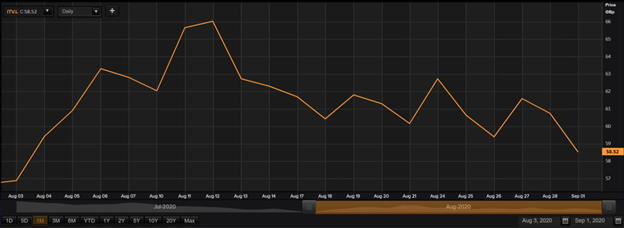
When the half-yearly results of the company were published in the first week of August 2020, the shares of the company saw a sharp drop on the London Stock Exchange. While at the time of the results released on 6 August 2020 the shares of the company were trading at GBX 63.30 it plummeted to GBX 62.02 by 10 August 2020.
Source – Thomson Reuters
From there the shares started climbing again to reach a month high of GBX 66.02 on 12 August 2020 but have since been on a downward trend on account of the FTSE 100 exit speculation. The shares of the company last closed at GBX 58.52 on 1 September 2020 at 9.55 AM. The market capitalisation of the company as on that date was £2.35 billion, and its 52 weeks high & low was GBX 165.90 and GBX 50.06, respectively.
Conclusion
ITV's exclusion from the FTSE 100 index is most likely to be a temporary one, as the company is expected be able to claw back on its revenue levels sooner than later. The advertisement revenues of the industry might have gone down, but its viewership levels have only increased during the lockdown. The arrival of the coronavirus vaccine by September and the upcoming festival season are expected to have a positive impact on the television industry, as advertisements might pick up fast as the year-end approaches, and people could be inclined to come out of their houses and spend more.
At the same time, one need to note that the threat to the British television industry from online broadcasting is rising by the day. However, most of the broadcasters have already started to adapt to it by making their content available online.
