
 AUS
AUS
 NZ
NZ
 UK
UK
 CA
CA
 USA
USA
 IND
IND

.jpg)




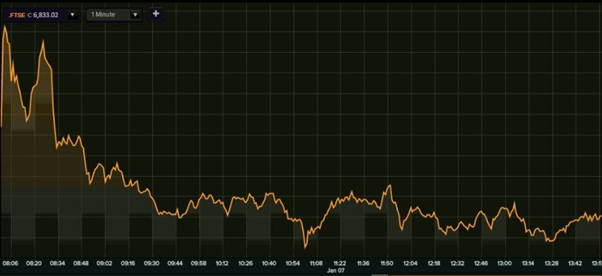
UK stock markets turned red in the late afternoon deals on Thursday, 7 January, after a Bank of England official warned of more Covid-19-led disruption in the financial markets. The FTSE 100 index slid into negative territory after starting on a positive note paring all the morning gains within an hour of opening trade. The wider market indices followed suit as a market-wide drop was observed with FTSE 250, FTSE 350 and FTSE All-Shares declining up to 1.3 per cent from the respective intraday peaks.
The central banks are required to have new tools to “deal with powerful investment firms” as the markets are likely to be affected “more frequently” from the disturbances developed by the coronavirus pandemic, news agency Reuters reported citing Andrew Hauser, the BoE’s executive director for markets.
Equities turn volatile
London equities continued to trade in the negative region after the knee-jerk reaction occurred in the morning. The FTSE 100 slipped as much as 0.68 per cent to a day’s bottom of 6,795.11 from the previous closing of 6,841.86. During the day so far, the headline index managed to touch a fresh 10-month peak of 6,903.61, nearing the psychological mark of 7,000. The index last touched a level of 7,042.47 on 27 February.
FTSE 100 (7 Jan)
(Source: EODHD/Others, Thomson Reuters)
Following the drop in most of the large-cap shares, the stocks of heavyweight companies including Unilever Plc (LON: ULVR), AstraZeneca Plc (LON: AZN) and HSBC Holdings Plc (LON: HSBA) tripped up to 2 per cent contributing majorly to the decline of the index.
The stock of Unilever shed as much as 1.28 per cent to a day’s low of GBX 4,410 from the previous closing price of GBX 4,467, while the share collapsed a little more than 2 per cent from the intraday peak of GBX 4,504. The stock of AstraZeneca and HSBC Holdings fell up to 2.2 per cent from the respective last market prices.
GBP extends losses
The GBP vs USD pair extended losses in the terminal trades after the domestic equities turned red. As per the latest foreign exchange data, the GBP to USD pair was trading at 1.3574, down 0.24 per cent from the previous closing of 1.3607 after oscillating between a high and low of 1.3633 and 1.3557, respectively. The Bank of England has fixed a reference exchange rate of 1.3550 USD and 1.1032 EUR against a unit of pound sterling on 6 January.
