
 AUS
AUS
 NZ
NZ
 UK
UK
 CA
CA
 USA
USA
 IND
IND

.jpg)



_06_19_2026_12_34_15_139937.jpg)

UK stock markets are expected to start on a negative footing on Friday, 29 January, as global equities extended the losses in the early session continuing the weekly drop. The futures linked to FTSE 100 were trading one per cent lower, indicating a negative opening for London equities.
Covid-19 worries persist
The Covid-led uncertainty seems to have unnerved the confidence of market participants once again in the topsy-turvy trading month so far. A position Wall Street finishing has failed to lift the market sentiments with Japan’s Nikkei 225 terminating 1.89 per cent lower, China’s Shanghai Composite ending 0.63 per cent down and South Korea’s Kospi losing 3.03 per cent at close.
The futures linked to DAX, Nasdaq, S&P 500 and Euro STOXX have been trading in negative territory signalling a major fall later in the day. The ongoing vaccination drive in the UK has not been able to reinstitute optimism among investors despite its wide reach.
GBP trips after crossing 1.37
The Great Britain pound (GBP) to the United States dollar (USD) fell into the negative region after soaring past 1.37 in the previous trade. Around 0743 GMT, the GBP vs USD pair was trading at 1.3697, down 0.16 per cent from the previous close of 1.3718 at the interbank foreign exchange market.
In the intraday session so far, the currency pair has oscillated between a high and low of 1.3737 and 1.3696, respectively. The Bank of England had fixed a currency conversion rate of 1.3704 USD and 1.1335 EUR against a unit of pound sterling on 27 January.
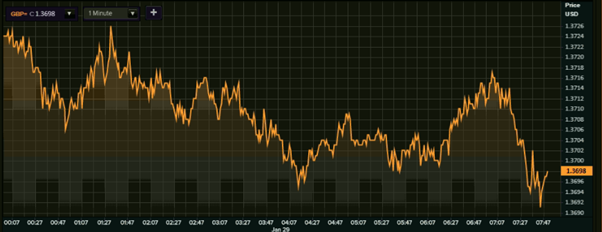
(Source: EODHD/Others, Thomson Reuters)
Study indicates a high rate of infection
A recent study conducted by the Imperial College London and Ipsos MORI has indicated that Covid infections have remained very high between 6 and 22 January with 1 out of 64 people being infected. The study has been carried on more than 167,600 volunteers.
The National Health Service (NHS) has been under significant pressure in England with the number of hospital admissions as well as people on ventilators being at the highest level at any point in time during the pandemic. More than 37,000 people have been administered in hospitals which is double the number of hospitalisations during the first peak in April 2020.
London has recorded the highest levels of infections across various regions with 1 out of 35 people being infected with the virus, while the national prevalence stood at 1.57 per cent or 157 infected per 10,000 people.
According to the study, care home workers, and healthcare workers have a higher chance of returning positive as compared to other workers. The findings of the study are a stark reminder of the requirement to stay vigilant despite the ongoing inoculation programme, said Health Secretary Matt Hancock.
