
 AUS
AUS
 NZ
NZ
 UK
UK
 CA
CA
 USA
USA
 IND
IND







US Markets: Wall Street started in the negative region on Thursday, 9 November, snapping the three consecutive positive sessions, with all the three major stock averages hovering in red as Omicron-induced uncertainty prevails. The equities have bounced back sharply in the present week, effectively retracing all the losses realised after the emergence of Omicron variant and the World Health Organisation cautioning about the prospective consequences.
Markets regained the much-needed momentum after the Chief Medical Advisor to the President of United States Anthony Fauci said the Omicron variant is not more severe as compared to the previously existing strains and the Delta variant.
Following the back-to-back upbeat sessions from Monday to Wednesday, investors have seemingly turned cautious as the vaccine makers, drug regulators, healthcare authorities, pharmaceutical corporations and other biotech companies continue to examine the severity of Omicron variant, its transmissibility, acuteness of symptoms, the time taken by the patients for complete recovery and the overall intensity of virus.
A large part of jittery is also due to the inflationary worries as the US Bureau of Labor Statistics readies to announce the rate of inflation. China’s consumer price based inflation rising to the highest since August of 2020 has categorically raised the volatility amidst the markets.
According to the National Bureau of Statistics of China, the CPI inflation rose to 2.3% in November of 2021 as faltering supply chain systems and repeated obstructions on the back of Covid-19 continue to fuel operational challenges. Earlier in October, the rate of inflation stood at 1.5%.
Meanwhile, the number of unemployment claims in the week ending 4 December decreased by 43,000 to 184,000. This has been the lowest number of US citizens filing new claims for unemployment benefits since September of 1969.
The less and less number of Americans seeking the unemployment benefits clearly exhibits the resilient employment landscape with a number of corporations rehiring thousands of employees collectively and other enterprises willingly retaining the skilled workforce as every other organisation wants to deliberately avoid a short-staffed scenario.
The Dow Jones Industrial Average dropped 34.28 points, or 0.10% to 35,720.47, the technology leader Nasdaq Composite plunged as much as 118.30 points, or 0.75% to 15,668.69, whereas the broader share indicator S&P 500 shed 16.19 points, or 0.34% to 4,685.02.
US Market News: Shares of Walgreens Boots Alliance only managed a gain of more than 1% amid the 30 blue-chip components of Dow Industrials on Thursday. The major positive points contributors include McDonald’s, Visa and UnitedHealth Group. On the other hand, shares of Boeing, Intel, Dow, and Verizon tripped 1-3%.
Shares of businesses operating within the hospitality industry mainly including travel and aviation slid into the negative territory as investors fear about the reintroduction of stern restrictions with the United Kingdom moving to Plan B as it aims to contain the spread of Omicron varint. The number of infections linked to the Omicron variant in the UK stood at 568.
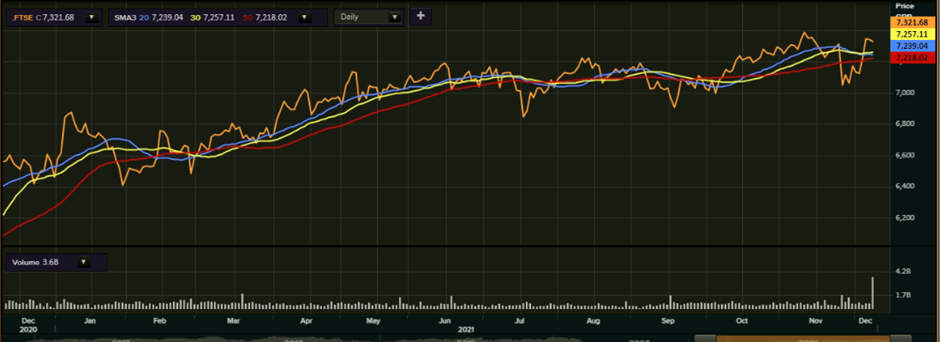
UK Markets: London equities followed suit on Thursday with the domestic benchmark FTSE 100 diving deeper in the terminal trades. The equity index traded largely flat until the mid-morning session, extended losses in the afternoon touching an intraday bottom of 7,302.96. Shares of BT, B&M European Value Retail, Intertek Group, Pershing Square Holdings, Halma, Rentokil Initial, Ferguson, Experian, Smith, Next, Sage Group, Darktrace, National Grid and DCC gained 1-3%.
On the contrary, shares of Rolls-Royce Holdings, International Consolidated Airlines, Entertain, Schroders, M&G, Intermediate Capital Group, London Stock Exchange Group, Abrdn, Barclays, Intercontinental Hotels Group, Melrose Industries, Ashtead, BP, Lloyds Banking Group, Royal Dutch Shell, Smiths Group, Johnson Mathey, Flutter Entertainment, Smith & Nephew, Evrax, Hikma Pharmaceuticals, NatWest Group, Compass Group and Prudential lost 1-4%, effectively counterbalancing all the rise provided by the major gainers.
The headline index FTSE 100 ended 15.79 points, or 0.22% at 7,321.26, while the mid-cap barometer FTSE 250 slipped 82.39 points, or 0.35% to 23,148.04.
FTSE 100 (9 December)
Source: EODHD/Others
Market Snapshot
Top 3 volume leaders:, Vodafone Group, Lloyds Banking Group, and BP
Top 3 sectoral indices: Industrial Services, Telecommunications, and Gas and Water
Bottom 3 sectoral indices: Automotive, Precious Metals, and Travel
Crude oil prices: Brent crude down 1.28% at $74.85/barrel; US WTI crude down 1.34% at $71.39/barrel
Gold prices: An ounce of gold traded at $1,777.35, down 0.46%
Exchange rate: GBP vs USD - 1.3205, down 0.03% | GBP vs EUR - 1.1698, up 0.45%
Bond yields: US 10-Year Treasury yield - 1.484% | UK 10-Year Government Bond yield - 0.7535%
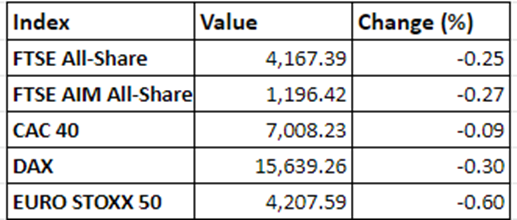
Markets @ 16:50 GMT
© 2021 Kalkine Media®
