
 AUS
AUS
 NZ
NZ
 UK
UK
 CA
CA
 USA
USA
 IND
IND






Summary
- Some thematic ETFs’ delivered a return of more than 30 per cent during the Covid-19 crisis
- FTSE 100 or Footsie fell by nearly one-fifth in value during the Covid-19 crisis
- A brokerage/share dealing account is a pre-requisite to invest in ETF’s
- For a know-nothing investor, investing in ETF’s could be a great starting point
ETFs (Exchange Traded Funds) began trading over a couple of decades ago and have been gaining popularity against more mature mutual funds. Moreover, the money invested in thematic ETFs has given decent returns in comparison to FTSE 100, the broader equity benchmark index in the UK during the pandemic time. The investors presently have a hoard of options to choose from. ETFs are relatively more liquid in nature compared to other forms of passive investments.
Most of the economic activities in the UK came to a screeching halt due to the spread of Covid-19. This led to the fall in demand for crude, which eventually affected the oil prices. UK’s broader equity benchmark index, FTSE 100 fell by nearly one-fifth in value. In addition, the uncertainties with reference to Brexit continued to mount pressure in already volatile markets.
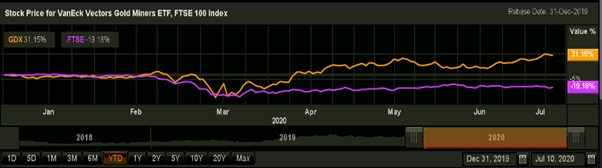
However, investing in ETF’s in these volatile times has gained popularity. ETF’s can be looked upon for diversification and access to various markets without really timing the market. For the safety of capital and modest returns, Gold ETF’s could be an ideal option. For instance, VanEck Vectors™ Gold Miners UCITS ETF (GDX), which tracks NYSE Arca Gold Miners Index has delivered a price return of more than 30 per cent in the Year to Date basis. Notably, Gold recently touched 8-year high of US$ 1800 per ounce last week.
(Source: EODHD/Others, Thomson Reuters)
The above chart represents the stock price comparison of GDX versus the FTSE 100 index during the coronavirus crisis. Since the lockdown in March, GDX has rallied. As the cure for the pandemic is likely to linger on for a few more months, the demand for these kinds of funds investing in safe haven may continue.
Why do investors like ETFs, and what is the reason for this growth?
ETFs have lower fees, compared to conventional mutual funds. They are more tax efficient as compared to other forms of pooled investments as they create and redeem units, and secondly, they are passively managed, which leads to fewer transaction costs. ETFs provide an effective way to invest in a part of the bond or stock market. ETFs can be purchased or sold at any time during the trading hours of a day, just like regular stocks on a stock exchange. They are a great way to diversify an existing investing portfolio.
An investor should have a brokerage/share dealing account; it is a pre-requisite to invest in ETF’s. Nowadays, there are many online platforms which provide access to several foreign exchange-traded funds, which help in gaining coverage to international markets, an easy way to hedge and gain country-specific exposure.
Also read: Dividend Growth ETFs can be meaningful for long term investors
Types of ETFs:
- Market ETFs: Designed to track an index like the FTSE 100 or S&P 500
(Source: EODHD/Others, Thomson Reuters)
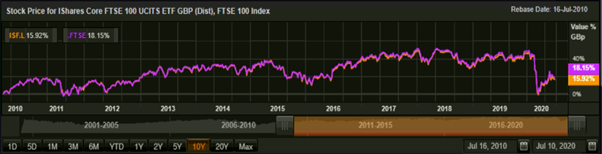
The above illustration represents 10-year chart, which shows that iShares Core FTSE100 UCITS ETF, which is market ETF tracking FTSE 100, clearly resonates with the FTSE 100 price movements.
- Bond ETFs: These allow risk-averse investors exposure to debt securities.
- Sector and industry ETFs: Designed to provide exposure to an industry, such as oil, pharmaceuticals, or high technology.
- Commodity ETFs: These allow investors to track the price of a commodity; for instance, gold has been rallying in recent times and has benefitted a lot of investors.
- Foreign market ETFs: Designed to track foreign markets, such as Japan’s Nikkei Index or Hong Kong’s Hang Seng index.
- Actively managed ETFs:Designed to outperform any index, unlike most ETFs, which are designed to track an index.
- Currency ETFs: These allow investors to invest in foreign currencies such as the Euro or the Dollar.
- Dividend ETFs: These allow investors with regular income
Also read: Exchange Trades Funds in the United Kingdom – Special focus on iShares Core FTSE 100 UCITS ETF
Advantages of ETF’s over equities
ETFs are professionally managed investments while the infinite upside potential is not foreseeable in any investment. It can be said that the asset/investment managers have professional knowledge, and the returns depend upon the strategy, which they deploy. However, the lack of expertise and access to market insights, tools could deter individual investors from reaping benefits.
Another thing to consider for investors seeking regular income is dividend income. A stock might pay or slash/cancel its dividend like many companies have done to preserve cash and stay afloat during these unprecedented times. However, dividend ETFs distribute income consistently based on the earnings by the fund from the stock it holds.
ETFs offer portfolio diversification for the investors, as it has a huge basket of securities. The gains and losses made by each security are offset, resulting in an overall positive or negative return of the investment. Using diversification in stocks is possible; however, it would require comprehensive analysis and expertise; which is not feasible for passive investors.
A stock market index is a snapshot of a majority of businesses trading in the economy. These businesses produce goods & services in an economy. With generations passing by, we tend to consume more products & services in comparison to the previous generation. Therefore, with the passage of time, the value of the index is likely to rise. Therefore, for a know-nothing investor or passive investor, investing in the index could be a good starting point. This could be done by two investment vehicles: ETF’s and Index funds.
ETF’s versus Index funds
Investing in ETF would require a brokerage or share dealing account; However, Index funds could be purchased from the asset management company. The expense ratio could be a notch higher for index funds in comparison to ETF’s as they are actively managed by fund managers. Buying and selling index funds might be cheaper in comparison to ETF’s because brokerage is not charged by the asset management company. The ETF’s could be bought within the market hours; however, Index funds are bought and sold at the closing price of the previous day. At the end of the day, the investor needs to find a way of investing in the index through cost-effective method.
For a know-nothing investor, investing in ETF’s could be a great starting point. Income seeking investors can look for dividend paying ETF’s. Investors who are looking to take indirect exposure into stocks might consider sector-specific ETF’s. Technology, Pharmaceuticals, Utilities, and Essential services sector were up and running during the unprecedented times.
