
 AUS
AUS
 NZ
NZ
 UK
UK
 CA
CA
 USA
USA
 IND
IND







Retail sales volume increased 0.9% in January 2020 in the United Kingdom.
The increase in retail volumes in January 2020 was mostly fueled by growth in food stores of 1.7 per cent and growth in non-food stores of 1.3 per cent. Fuel sales dropped by 5.7 per cent in terms of purchased quantity in January 2020 against December 2019 on account of price rise of 2.3 pence per litre between December 2019 and January 2020. Retail sales through the online medium stood at 19 per cent of the total retail sales for the month of January 2020 compared to 19.3 per cent for the month of December 2019. In terms of the amount spent on retail, the fall for the quarter ending January 2020 was 0.5 per cent in terms of amount spent and 0.8% in terms of quantity bought but for January 2020 the amount spent increased by 1.2 per cent and the quantity bought increased by 0.9%.
The average retail sales volumes for the three months of November 2019, December 2019 and January 2020 have declined by 0.8 per cent in the United Kingdom compared to the previous three months. The data published by the Office of National Statistics of the United Kingdom also states that the month of January was an aberration among the three months and recorded a growth of 0.9 per cent in retail volumes.
Retail sales growth over the past few years have been on an upward trend despite the negative headwinds of Pre-Brexit jitters.
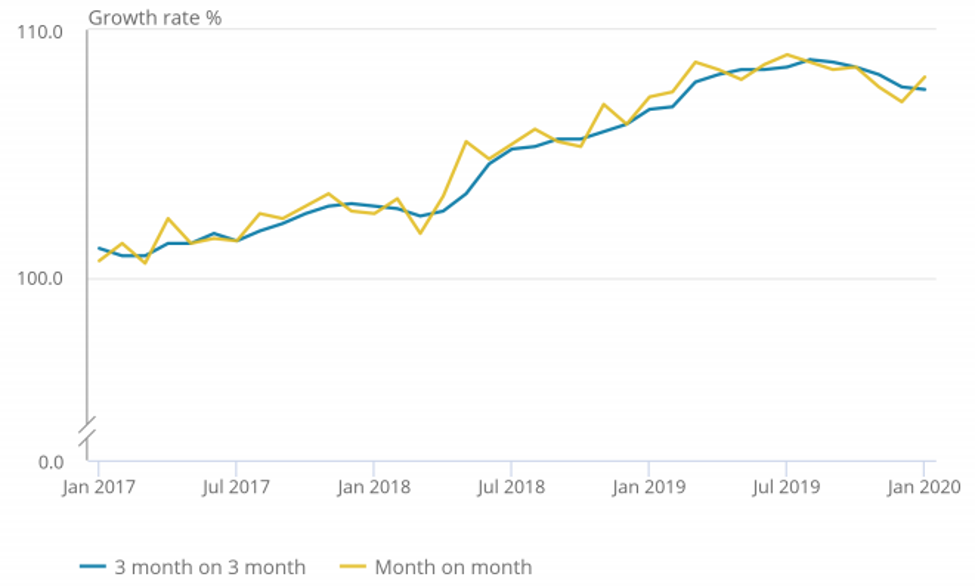
Picture Source â Office of National Statistics (three months seasonally adjusted from Jan 17 to Jan 20)
A decomposition of different retail items that contributed to the deceleration of the retail growth rate for the quarter ended January 2020 shows that Fuel stores sales decelerated the most by -1.3 per cent (quarter on quarter) during the period; this was followed by non-food store sales which slowed down by -1.1 per cent (quarter on quarter). The food store market segment during the period fell by -0.7 per cent (quarter on quarter), and lastly non-store retailing fell by -0.1 per cent (quarter on quarter). Within the Non- Food stores segment, Department stores sales for the period fell by 1.2 per cent, Textile, clothing and footwear stores sales fell by 1.5 per cent, followed by Household goods stores sales which fell by 0.5 per cent, followed by other stores sales segment which fell by 1.0 per cent.
January 2020 retail sales growth rate decomposition on the basis of the contributing factors reveal that the sector which registered the most deceleration was the fuel stores sales sector which fell by 5.7 per cent (month on month). The non-store retailing segment for the month grew by 2.5 per cent (month on month) followed by the food stores sales segment which grew by 1.7 per cent (month on month) and finally the non-food stores' sales segment grew by 1.3 per cent (month on month) during the period.
Within the non-food stores' sales segment Textile, clothing and footwear stores segment registered the maximum growth of 3.9 per cent followed by Department stores sales segment which grew by 1.6 per cent, which was followed by other stores sales segment which grew by 0.4 per cent. However, the Household goods stores sales segment fell by 1.1 per cent during the period.
Fuel stores sales for both the periods in question (month on month as well as quarter on quarter) have been a significant contributor in deceleration of growth. Part of the reason has been the increase in oil and gas prices of 2.3 pence per litre between the periods of December 2019 and January 2020. The growth in fuel prices has a cascading effect as it implicitly led to an increase in the costs of others which eventually translated to lower than potential growth in other contributing segments of the retail sales sector for both the periods.
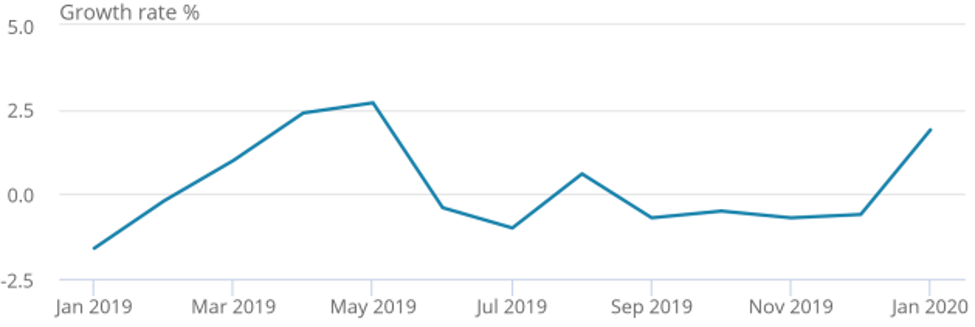
 Picture Source â Office of National Statistics (fuel avg store price growth rate between Jan 19 & Jan 20)
In terms of actual money spent almost all of the segments excepting the Fuel stores segment showed a growth.
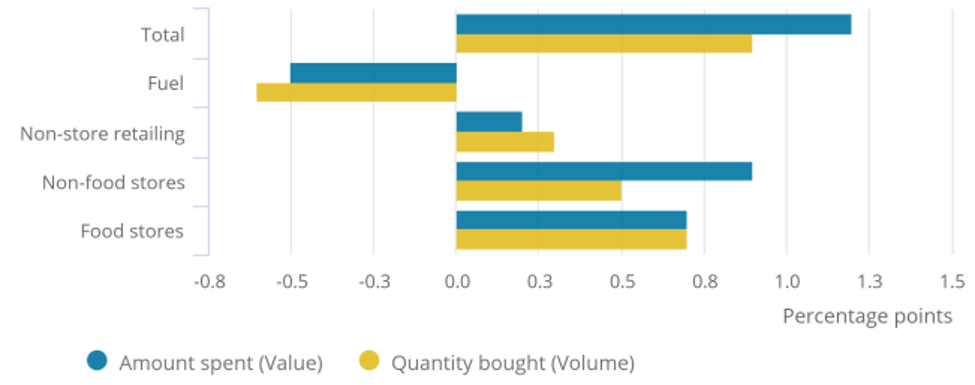
Picture Source â Office of National Statistics (amount spent & Qty Bought of different segments on Jan 20)
The fuels stores sales segment for January 2020 saw less amount being spent on fuel compared to volume deceleration. In the Non-Stores retailing segment growth in volumes was more compared to the absolute amount being spent, for non-food stores sales segment however the amount of money spent far exceeded the volume growth, and surprisingly the growth rate of the volume and amount spent were almost same for the food stores sales segment.Â
The online retailing segment is fast becoming a significant segment of the retail sector in the United Kingdom. In January 2020 it commanded nearly one-fifth of all retail sales in the country. Decomposing the growth of this segment of the retail sector reveals that for the month of January 2020 non-store retailing segment contributed nearly 5.1 per cent growth to the segment while online sales as a proportion of total Non-store retailing segment stood at 79.4 per cent. The non-food segment contributed nearly -6.8 per cent growth to the segment while online sales are a proportion of total Non-food retailing segment stood at 14.2 per cent. The food segment contributed almost 5.7 per cent growth to the segment while online sales are a proportion of entire Non-store retailing segment stood at 5.3 per cent.
Within the non-food retail segment of online retail sales, the department store segment contributed nearly -4.8 per cent growth to the segment while online sales as a proportion of total Non-store retailing segment stood at 15.4 per cent. The Textile, clothing and footwear stores segment declined nearly 0.7 per while online sales as a proportion of total Non-store retailing segment stood at 17.3 per cent. The Household goods stores sales segment declined nearly 26.7 per cent while online sales as a proportion of total Non-store retailing segment stood at 13.1 per cent, and the Other stores sales segment with online sales contributed nearly 2.2 per cent growth to the segment while online sales as a proportion of total Non-store retailing segment stood at 11.3 per cent.
Among the above sectors, the maximum weightage to the index was that of Non-store retailing, which was about 50.7 per cent, followed by the non-food retail sales segment having a weightage of 36.0 and all food segment having a total weightage of 13.3 per cent.
For the month of February 2020 also it is expected that the retail sales data will be stronger than January 2020 sales data given the data release of many other economic indicators for February are already looking up.
