
 AUS
AUS
 NZ
NZ
 UK
UK
 CA
CA
 USA
USA
 IND
IND

_07_03_2026_03_50_21_133108.jpg)



Summary
- Current trend in the oil prices indicates a slow upward trend, recovering from a severe slump
- Oil producing companies are looking for ways to survive
- A gradual improvement in demand for the fuel in post lockdown era is expected
The latest trend in prices of Brent crude oil (a blend of crude oil from the North Sea basin, used as a benchmark for UK oil prices) indicates a slow upward trend, after falling to a 20-year low trough of 19.33 dollars per barrel on April 21 this year, raising serious concerns about the future of the nation’s oil industry.
The OPEC basket oil prices (the most crucial benchmark for the global crude oil industry) have displayed a similar trend over the past one year. They had peaked in the month of January 2020, at $70.89 per barrel. Since then, a downward trend is continuing.
Till February, the falling prices were a result of the global economy going through a structural recessionary phase (February 6 at $55.72).
However, since March this year, the crashing prices came about as a result of the corona pandemic led serious disruptions across the world, where the demand for oil fell sharply and suddenly (March 26 at $26.04 a barrel).
They plummeted to a lowest ever level of $12.22 on April 22, initiating a row of global concern for the future prospects of the sector. Since then the prices have gradually started to move up, with companies across the world announcing production cuts.
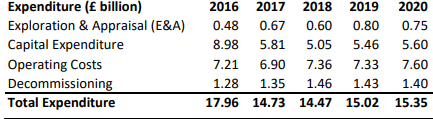
Oil and Gas Authority’s Projections of UK Oil and Gas Production and Expenditure
Feb 2020 Update

(Source: Government of UK Statistics)
As per the latest statistics available from the Oil and Gas Authority of UK, the production of crude oil is slated to fall to 47.68 million tonnes in the year 2020 from 48.62 million tonnes produced a year back. On the other hand, the expenses are showing a diverse trend and are expected to rise from £15.02 billion in 2019 to £15.35 billion in 2020.
Impact of falling prices on the oil industry in the UK
So, before we jump to this, just to answer a very basic question as to how the oil users get impacted with a falling price of oil-they do benefit. The immediate positive of any oil price fall is that the transport and fuels cost go down for all consumers, be it individuals or companies. But it is good for the economy as on whole only if this lower price can be sustainable by the industry and they are still left viable to produce oil and keep making profits.
Now coming to the impact on the oil industry in the United Kingdom, it is badly hit with sharply dwindling prices of oil. This has driven investment to the lowest levels ever in the sector with no new explorations, also has led to drastic production falls, the construction work at existing oilfields is stalled, and companies are facing closures. The leading trade association firm Oil and Gas UK (OGUK) has warned that during the next year and a half, close to 30,000 job losses are expected in the country’s oil and gas sector.
With supply outstripping demand for oil, it is getting tougher for oil companies to be able to store the excess oil. Companies are being forced to cut down on their production levels. Exploration drilling has come to a complete halt.
A recent study by the University of Aberdeen has predicted that if the price of Brent crude oil is $45 a barrel, more than 25 percent of the oil in the North Sea basins will be left uneconomical to produce. If this price stoops further to $25 a barrel, this comparable number will go up to 33 percent.
Oil companies are now spending money on decommissioning, which simply means undertaking operations to end producing oil. It involves activities related to dismantling and disposing of the assets and leaving the ocean floor as it existed earlier. It is estimated that the total value of decommissioning projects across the world will shoot up to $42 billion by the year 2024. About 23 assets on an average will end production in the North Sea basin in the next 5 years, the main source of oil for the UK (The British North Sea produced 1.7 million barrels oil daily in 2019). Top UK oil giants like Shell and Total are likely to spend 10 percent of their total North Sea spend on decommissioning themselves. Shell is closing its Brent field, one of the largest fields in the region, with an expected expense of $3 billion over the coming years.
The ailing industry is also seeking Government’s support in the form of direct investment, tax-breaks, job securities and infrastructure support. It is expected for the Government to come out with a plan to retain and re-train the oil industry workforce so that they can get jobs again. The UK North Sea trade unions have also urged the British Government to purchase a stake in North Sea operating companies.
On a good note, the prevailing low oil price scenario is a definite possibility to explore options that can cut down the production cost of the oil-producing plater across the nation. It is widely expected that the rig and vessel rates will reduce in the next two years.
Company profits under pressure
Total SA’s net profits hit a figure of $1.8 billion for the first three months of 2020, down by 35 percent from last year’s quarterly numbers.
BP’s net income was down by two-thirds in the period of January to March of 2020, from $2.4 billion a year back. It was hit by a slow demand as well an unprecedented supply pull.
Royal Dutch Shell slashed its dividends by 66 percent in April this year. It came as a big blow to investors. The company has announced that it will prune its refining capacity by up to 40 percent for Q2 2020. Its earnings also dropped by 46 percent for Q1 2020, as compared to last year.
Oil companies might also go cash negative, it is being predicted by various oil industry analysts.
Impact on the UK economy
An ideal impact of falling oil prices on the economy, given other things, are constant, is that the disposable income rises and people get more money to spend on other goods and services, so an oil price fall actually fuels economic growth.
But not in extraordinary times, like the corona led lockdown and recession, where people wish to hold on to their cash due to various uncertainties including rising unemployment, movement restrictions, a dramatic fall in demand, near-zero inflation and a big scare due to the pandemic etc.
It shows that the demand from all the oil using sectors is very low, like electricity, air travel, land transport, farming, oil intensive manufacturing, water travel, retail, construction etc.
Therefore, in today’s scenario, a falling oil price is an indication of a serious global economic recession, which can be only reversed if economic activities resume in full force.
Future trends
With lockdowns easing in the UK and throughout the world in a gradual manner, the demand is also picking up, but in a similar fashion. At the same time, it’s too early to predict the exact pattern, as the risk of repeat outbreaks and lockdown persists till the pandemic gets over. With the Chinese economy already up and running to near full capacity, oil demand has risen by more than 2 million barrels per day. It is predicted that the total oil demand could go down by up to 10 percent for the year 2020 due to economic recession and lesser travel throughout the world.
Further, the leading oil producers are aligning themselves and planning to restrict supply in the coming few months. OPEC+, which is a 24-member nation group of oil producers that include Russia, has decided to lower oil output by 10 million barrels per day for May and June this year, to check the supply-demand mismatch. In a similar move, oil companies in US and Canada have also lowered the crude’s output by 1.7 barrels per day.
In fact, with these market corrections in place, Brent oil futures have been showing some optimism in May. Brent crude jumped on the Intercontinental Exchange (ICE) during the month this year and was seen hovering around $35.81 per barrel on May 26, despite the growing politico-economic tension between US and China. This was also because on the same day the UK Government announced that from June 15 all non-essential retail services would be opened, raising optimism for the oil industry.
So, it is being predicted by the EIA (Energy Information Administration, US) that the Brent crude oil prices will be maintained at $32 per barrel for the second half of the year 2020. For the year 2021, the Brent crude oil prices are projected to reach an average of $48 per barrel, with the fuel demand continuing to recover.
The UK Government is also in talks with the oil industry to produce a package for the North Sea oil sector and face the COVID situation and sail through these unprecedented times. So good times are hopefully ahead for the industry, but we will need to wait and tread with caution till the corona pandemic gets phased out.
