
 AUS
AUS
 NZ
NZ
 UK
UK
 CA
CA
 USA
USA
 IND
IND







Summary
- Canada’s trade deficit shrank to C$ 677 million in May from revised April figures of C$ 3.3 billion, said Statistics Canada.
- Imports fell 3.9 percent in May to a nine-year low of C$ 35.29 billion over supply hiccups around the world.
- Canadian auto sales fell by about 45 percent YoY in the second quarter due to COVID-19 pandemic.
Canada’s trade deficit shrank to C$ 677 million in May from revised April figures of C$ 3.3 billion on the back of resumption of economic activities after country-wide easing of lockdown, said Statistics Canada. The figures stand in sharp contrast to analyst projections that expected the trade gap to be around C$ 3 billion. This is smallest trade shortfall since November 2019, says data site TradingEconomics.com.
Trade deficit occurs when the value of imports exceeds exports, creating a negative balance of trade. It leads to shortage in balance of payments and can affect the overall economy.
Canada’s exports grew by 6.7 percent to C$ 34.6 billion month-over-month (MoM) in May, riding on 76.2 percent surge in the sales of motor vehicles and parts following resumption of operations in the auto industry. Also contributing to the export numbers are a 14.5 percent rise in energy products sales due to recovery in crude oil prices.
However, export of motor vehicles and parts declined by about 80 percent year-over-year in May. Crude oil exports still lag, accounting for barely one-third of the value reported in January 2020.
Imports fell 3.9 percent in May to a nine-year low of C$ 35.29 billion. The decline was due to supply hiccups faced by various economies over lockdown measures around the world. Canada’s trade surplus with the United States rose to C$ 2.8 billion in May from C$ billion in April. However, Canada’s trade gap with other countries fell to C$ 3.5 billion in May from C$ 5.5 billion in April, marking new lows in more than three years .
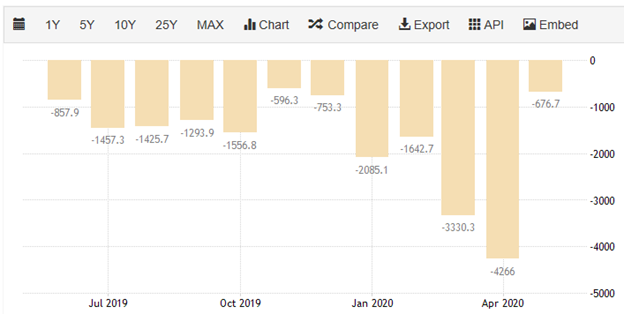
Canada’s trade deficit (Source: tradingeconomics.com)
Analyst estimates say Canada’s balance of trade will be down by C$ 1500 million at the end of current quarter and decrease by C$ 1100 over 12 months. By 2021, the balance of trade is be approximately minus (-) C$ 500 million, projects TradingEconomics.com.
Despite being weighed by COVID-19 and oil prices, the Canadian dollar has strengthened against the greenback in May.
Canada’s Automotive Industry
Canada’s automotive industry is a key contributor to the country’s GDP and among the world’s top ten producers of light vehicles. The auto industry forms the country’s largest manufacturing sector. It makes up 10 percent of manufacturing GDP and 23 percent of manufacturing trade including the assembling of more than two million vehicles of five global original equipment manufacturers (OEMs) such as FCA, Ford, General Motors, Honda and Toyota.
The country attracts not only investments from OEMs but also from tech giants like Uber, Google and Nvidia. Canada also possesses the expertise in commercial equipment and public transportation manufacturing. The companies that hold the largest market share in car and automobile manufacturing sector are FCA Canada Inc. and Honda Canada Inc.
Due to COVID-19 pandemic, Canadian auto sales fell by about 45 percent YoY in the second quarter. During the period, both FCA Canada and Ford Canada posted about 47 percent decline in auto sales. Sales drop was reported by General Motors (35.5 percent), Honda Canada (45.6 percent) and Toyota (48.7 percent). In addition, Windsor built Pacifica minivan’s sales fell 72 percent, Canadian-built Charger’s sales fell 87 percent and Challenger sales declined by 52 percent. However, May and June numbers show an improvement.
FCA Canada Inc.
FCA Canada Inc., formerly known as Chrysler Canada, is the wholly owned subsidiary of Fiat Chrysler Automobiles. The company operates in Canada and manufacture passenger cars, jeeps, light trucks etc. In the second quarter of 2020, FCA Canada had sold 33,718 vehicles compared to 63,410 in the corresponding period last year. Sales of FCA's Windsor-made Pacifica minivan fell by 52 percent year-to-date as compared to the same period last year.
The group reported an adjusted net loss of €0.5 billion for the first quarter of 2020 over COVID-19 impact but posted a positive Adjusted EBIT. At the end of the March 2020, the group had a liquidity of €18.6 billion. The group’s North America segment, including Canadian operations, reported 16 percent decline in its shipments the first quarter, mainly due to temporary suspension of production. Net revenues of the segment declined 9 percent while Adjusted EBIT of the segment fell 48 percent due to fall in net revenues and rise in industrial costs.
Ford Canada
Sales of Ford Motor Canada fell by 45 percent to 50,546 units during the second quarter of 2020 due to COVID-19 outbreak. Sales decreased at both Ford and Lincoln Motors. But year-over-year sales grew for Ford Explorer and Ford Ranger. The company has recently released an all-new version of Canada’s top-selling vehicle, which is the Ford F-150, and the company is getting positive feedback from its customers for this truck. The company has also started getting bookings for its all-new electric Ford Mustang Mach-E and intends to debut its highly anticipated all-new Ford Bronco SUVs in July 2020.
