
 AUS
AUS
 NZ
NZ
 UK
UK
 CA
CA
 USA
USA
 IND
IND






Highlights
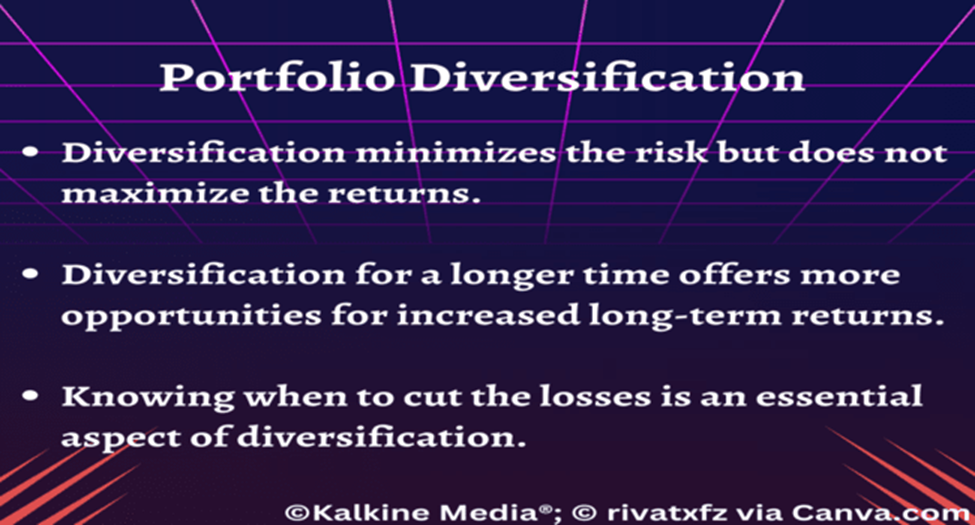
- Diversification minimizes risk but does not maximize the returns.
- Diversification for a longer period offers more opportunities for increased long-term returns.
- Knowing when to cut losses is an essential aspect of diversification.
Diversification is a risk management strategy that plays a crucial role in the market. This is for all the investors irrespective of the level on which they are operating. The basic concept is not putting all your eggs in one basket.
The strategy facilitates spreading the money across multiple sectors and industries. So, if a sector goes for a toss and incurs losses, the whole portfolio does not get affected. It gives a mix of returns, thereby balancing the investment for the long term.
Why Is Diversification Important?
For an investor, the main goal is to improve wealth and minimize the risk as much as possible. Diversification solves this purpose and manages the portfolio effectively. With proper analysis, you will not rely on one sector and get exposed to its profits and losses. In other words, diversification is a crucial strategy to lower the unsystematic risk coming from different sectors and industries.
-
Minimizes Risk
Diversification minimizes the risk but does not maximize the returns. There is a thin line between these two concepts that are important to understand. The focus area of the strategy is to shield from market fluctuations and reduce volatility in your investments. It may not fully eliminate the risk but reduces the asset-specific risks.
-
Grants More Opportunities for Return
Diversification for a longer period offers more opportunities for increased long-term returns.
-
Protects from Market Volatility
Volatility is one of the important aspects of the equity market. For an investor to make profits, the market needs to be on an upward trend. But the market is not always favorable. Hence, diversification minimizes the risk of loss when the market is hit by a downturn.
Tips for diversification
Diversification is easy to do but requires proper planning to implement. It allows the investor to add several stocks at one time thereby creating an index fund. At that point, the investor may feel better off buying an index fund and avoiding the transaction fees. However, proper diversification can lead to risk mitigation and improved performance.
-
Spread Your Wealth
Spreading your wealth is crucial. Do not put all your wealth in one sector or industry. Instead, spread your investment across sectors and industries. Look for stocks that you trust.
-
Look Into All Options
While dealing in the market, you may add an index fund to your portfolio. Index funds are investment vehicles that provide diversification across multiple index classes.
-
Keep Adding to Your Portfolio
Try to avoid the peaks and valleys of market volatility. Focus on recurrent investments barring these two points. This will keep your portfolio active and diversified.
-
Know the right time to exit
Knowing when to cut losses is an essential aspect of diversification. If your investments are on autopilot, do not lose track of market trends. Also, it is important to know when to stop and exit.
Bottom Line
A well-diversified portfolio invites substantial growth and lowers the risk. Diversification is vital in investment management and financial planning. By investing in a variety of stocks, the investor is less prone to the risk of losing capital.
Additionally, with digitalization, diversification has become easy and effective. Hence, keep your portfolio diversified to be in the race for the long-term.
Please note, the above content constitutes a very preliminary observation based on the industry and is of limited scope without any in-depth fundamental valuation or technical analysis. Any interest in stocks or sectors should be thoroughly evaluated taking into consideration the associated risks.
