
 AUS
AUS
 NZ
NZ
 UK
UK
 CA
CA
 USA
USA
 IND
IND







Highlights
- An exchange-traded fund (ETF) is a pool of securities that track assets, commodities, indexes, and sectors.
- ETF’s history in Canada dates back to March 1990.
- They are known to provide investors with tax-efficient, cost-effective and pooled investment vehicles.
Canadian exchange traded funds (ETFs) offer various asset classes, from commodities, fixed income to equities, alternative mandates, real estate, etc.
These are known to provide investors with tax-efficient, cost-effective and pooled investment vehicles.
ETF’s history in Canada dates back to March 1990 when a new kind of financial product, Toronto 35 Index Participation Units (TIPs), was listed on Toronto Stock Exchange (TSX).
TIPs are generally considered to be the first ETF, or at least its predecessor. Today, the original fund (now known as iShares S&P/TSX 60 Index) is still operational even after three decades.
The Canadian ETF market continues to grow and innovate, with over 700 exchange-traded funds listed on the Toronto Stock Exchange alone. By 2013, only ten firms were offering Canadian-listed ETFs, but at the end of the fourth quarter of 2020, there were 39 sponsors, representing a CAGR of 20 per cent over a decade.
Also read: Growth vs Value investing: All you must know about two stock market approaches
What is an ETF?
An exchange-traded fund (ETF) is a pool of securities that track assets, commodities, indexes, and sectors.
The exchange-traded fund can be tailored to track anything from a diverse class of securities to an individual commodity. Further, it can be structured for tracking peculiar investment strategies.
The basket of securities may contain different investment options like commodities, bonds, stocks, or a mixture of investment types. In addition, an ETF has an associated price, which allows it to be bought and sold on the stock exchange platform.
Like mutual funds, ETFs also carries potential risks like currency risk, liquidity risk, market risk, etc.
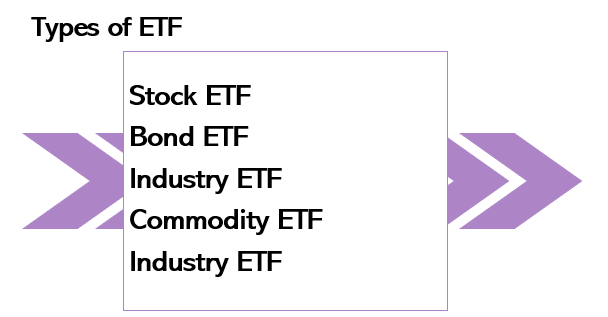
Types of ETFs
Exchange-Traded Funds can be tailored to meet specific requirements like income generation, prices increase, speculation, hedging, or to partly offset investor’s risk. Various types of ETFs include:
- Bond ETFs
This type of ETF is created to provide consistent source of income as its income distribution depends on the value of underlying securities. Unlike its underlying instrument, bond ETFs do not have a maturity date. Usually, bond ETFs are traded on discount or premium from the actual price.
- Stock ETFs
The primary aim of Stock ETFs is to provide diverse exposure to a single industry vertical.
Copyright © 2021 Kalkine Media
- Commodity ETFs
As its name suggests, this particular type of exchange-traded fund includes investment in commodities like gold, crude oil or natural gas. The main advantage of commodity ETF is that commodity like gold does not require physical possession.
- Currency ETFs
The exchange-traded funds represent different investment vehicles structured to track foreign and domestic currencies.
A peek into Canadian ETF market
In the past few years, the ongoing development of the Canadian ETF market could be attributed to a secular shift among the investors that boosted the share of Canadian-listed products.
Today, the ETF market in Canada has matured since its inception and offers several solutions peculiar to the Canadian ETF landscape. The home investors can now gain exposure to a rising number of strategies and asset classes through domestically listed products.
The Canadian ETFs have evolved beyond its index-replicating origins as the sponsors continue to broaden the scope of offerings. The new ETF entrants provide non-index tracking, quantitative model-based, strategic-beta indices tracking, and exposure to the thematic investment mandate.
Also read: 11 Best TSX ETFs to buy
According to the Canadian ETF Association, the non-index tracking ETFs have picked up pace in recent years, i.e., 232 of the total 486 such ETFs were launched between 2015 and 2018. Despite index-tracking funds retaining most of the assets under management, the non-index tracking ETFs have the lion’s share in the Canadian product profile.
Equity index trackers are generally the Canada’s largest ETFs among other traditional index tracking funds. There are 466 index-tracking ETFs as of September 2020 and 362 non-index-tracking ETFs that represent diversified asset classes.
The Canadian ETFs achieved significant development in recent years, and by 2019, 117 new funds were launched comprising 12 balanced mandates, 78 equity and 27 fixed-income.
Due to increasing popularity of ETFs among retail investors, the sponsors also expanding their offerings to meet the growing demand.
ETFs mechanism in Canada
A mutual fund manager forms and manages the ETF portfolio by selecting bonds, stocks, or other securities based on pre-determined financial goals, associated risks, and an overview of the underlying financial instrument (type and quantity). How many units an investor will own depends on the value of fund units, amount invested, and change in price of bonds or stocks.
However, unlike mutual funds, ETFs have an altogether different approach to creation, purchase, and organization. The ETFs function differently from mutual funds as they represent an entire index, a measurable and defined basket of bonds and/or stocks, or a subset of it. Barring active managed ETFs, the ETFs pursue no specific limit on holdings or active selection of securities.
The investor engages in the trading of ETF units either directly from an online broker or through an advisor/broker. This is done through or on a stock exchange like the TSX.
Even though ETFs operate as a pool of funds, it is treated like a marketable security that is traded and listed on a stock exchange. However, it’s not the case with the mutual fund units, which are bought and sold through the mutual fund firm.
How are ETFs created & managed?
In Canada, Designated Market Makers or Designated Brokers (DB/DM) are responsible for the creation of ETFs. These investment professionals operate in financial institution’s capital markets divisions and are authorized by an ETF provider to redeem or create ETF units.
The fund manager provides the ETF distributor with a file that contains all the securities that an ETF should hold according to the specific index it follows. The Portfolio Listing File is used throughout the following T-day to generate a real-time value of a single ETF unit.
The group of stocks that the designated broker purchases or sells is called ‘creation basket.’ This basket represents the whole portfolio of securities that the ETF will hold and determines its intrinsic net asset value, which depends on the price of securities during the T-day.
Also Read: Are ETFs good for investment?
The transaction between an ETF provider and designated broker usually happens in a prescribed number of units (large blocks of shares) that allow an ETF to either grow and shrink or both in total assets. It then responds to investor activity, i.e., to buy or sell units.
Buying and selling of units usually occur during a normal T-day, like 9 am to 5 pm. However, other activities like booking any trades into custody or establishing indicative NAV may occur at the end of the day, which is 4 pm to 8 pm.
The ETFs are designed to mirror or track an index to facilitate investors to invest based on a specified index. After the investors make their purchase, they are provided with an ETF Facts Summary document within two business days, identifying which index a Canadian ETF would track.
How ETFs Respond to Market Value Changes?
The value of underlying securities is constantly changing due to which the index that tracks the ETF and value of ETF unit are always changing.
The ETF fund manager trades the underlying securities or the units on the stock exchange until the value of ETF units gauge with the underlying stocks or bonds. In layman terms, it is an act of rebalancing demand and supply so that the intraday fair value of ETF units and its index consistently match.
In Canada, two exchanges, i.e., TSX and NEO Aequitas Exchange, actively lists and trades ETFs. The Canadian Securities Exchange trades ETF but does not carry any listing activity. However, there are 12 other markets where ETFs are traded in Canada.
Where do Canadian investors trade ETFs?
With a well-developed ETF infrastructure in Canada, the investors have a hassle-free access to the distribution network for ETFs, comprising various channels.
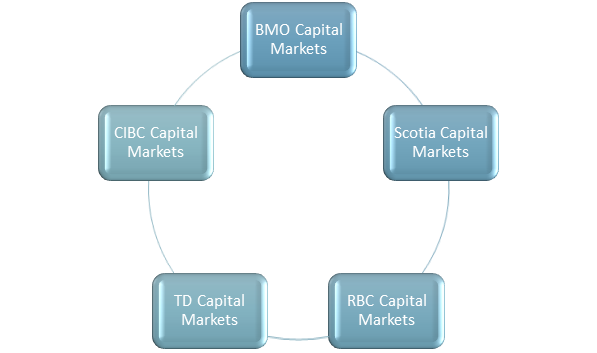
The financial services market in Canada is dominated by six major banks that act as designated market makers/designated brokers and ETF distributors.
Copyright © 2021 Kalkine Media
The six financial institutions function through inhouse advisors that offer ETFs, online/discount brokerage, and full-service brokerage arms, which facilitates the investors with trading of ETFs, either their own or of third-party. In addition to the major banking firms, the Canadian ETF distributors’ network consists of several independent companies offering ETFs.
Also Read: ETF Vs Stocks: Where to invest for best growth
The distribution network broadly comprises licensed portfolio managers, boutique brokerage, standalone online/discount brokerage, financial advisories associated with some brokerage-licensed firms, and robo-advice platforms.
Listed ETFs based on different distribution channel
Full-service brokerage: It is an important retail distribution channel available for exchange-traded funds. In the third quarter of 2020, it accounted for nearly 54.4 per cent of total retail assets.
Online/Discount Brokerage: The channel contributed the second-largest share to retail ETF ownership in December 2019, representing 34.1 per cent of assets.
Robo-advice channel: The digital platform held the third-largest share of assets in 2019, with a reported 60.2 per cent increase since 2018.
Some of the major Canadian indexes include:
- S&P/TSX Composite: It is a headline index that measures the performance of stocks representing 10 Canadian business sectors.
- S&P/TSX 60: The index represents stocks of 60 large-cap companies in the Canadian equity market. It is a market-cap weighted and float-adjusted index.
- S&P/TSX SmallCap: Launched in May 1999, the float-adjusted index represents the Canadian small-cap market, comprising 192 companies as of June 30, 2020.
- S&P/TSX Venture Composite Index: Covers micro-cap securities in the Canadian equity market, with major stocks for firms engaged in the materials industry.
Bottomline
In conclusion, the Canadian ETF industry seems promising as various well-established companies offer evolving product mix with market expertise, scale, and sophisticated distribution networks to investors.
