
 AUS
AUS
 NZ
NZ
 UK
UK
 CA
CA
 USA
USA
 IND
IND

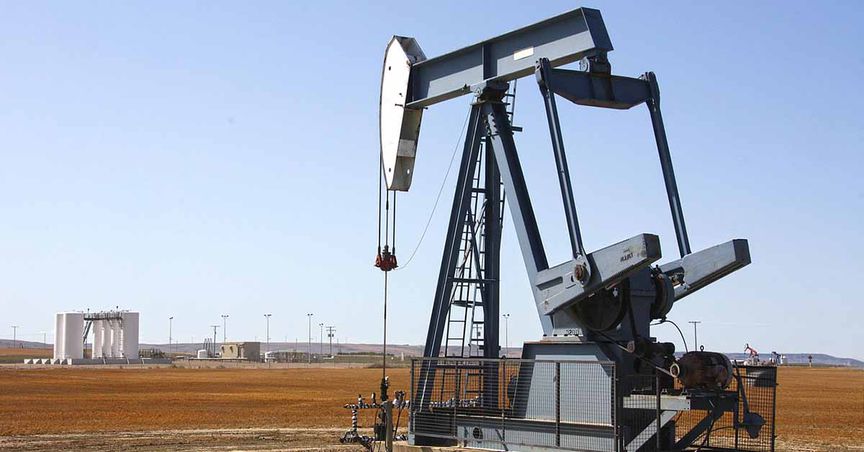





The oil industry in the current avatar took birth in the mid-19th Century with the discovery of the world's first commercially sustainable oil well in the USA. This event went on to mark a new journey for mankind like never before. It would not be an exaggeration if we call Oil the internet of the industrial age.
The hunt for Oil quickly became an extremely important activity for many pioneers, and one such tall figure in the oil industry was John D Rockefeller, who took the industry to the next level by consolidating it via Standard Oil. As the industry grew the technology used to discover oil and eventually extraction of Oil became more sophisticated.
With the advancement in exploratory techniques and Oil drilling techniques, new oil reserves and resources were discovered across globes from sources such as Oil sands and Shales, which were impractical to even think of, for commercial exploitation by the mid of 20th century.
Estimating the Oil Available for Extraction
It is difficult to know how much oil is under the surface of the earth. One can only estimate the total amount of oil that can be recovered and produced from a specific area. Moreover, it is just not technically feasible to recover most of the oil from any given reservoir.
There are two major classes of resources, other than reserves-
Contingent Resources accounts for the potentially recoverable volumes as per the development plan which targets the already identified volumes but is still not commercially feasible.
Prospective Resources is the resource segment which includes the volumes which could be potentially extracted as per the current development schedule targeting the volumes yet to be identified.
Oil reserves are estimates of how much crude oil can be recovered from an area under existing operating and economic conditions. Based on how likely oil can be recovered using existing technology, discovered oil reserves are categorised into –
Proven Reserves – These are the estimated oil quantities that can be recovered from known reservoirs in the future. When a project is found to have proven reserves, it means that there is a more than 90% chance that oil will be recovered and produced over the life of the field.
Under this category, only that oil is counted which is commercially viable for recovery in the current economic conditions.
In 2018, globally, there were 1.73 trillion barrels of oil, enough to meet the global need for the next 50 years, as daily oil consumption is 95 million barrels.
Probable Reserves – Also, known as indicated reserves, this category of oil reserves is estimated to have a greater than 50% chance of being technically and economically producible.
Possible Reserves – Possible or inferred reserves are estimated to have significant, but less than 50% chance of recovering the oil in place.
Over time, some portion of probable and possible reserves at a field can get converted to proven reserves.
Bowsprit Oil Project from Contingent Resources to Reserves
United States, which was found to hold one of the top 15 oil reserves in 2018, had 43,824 million barrels of proved oil reserves at the end of December 2018.
Bowsprit Oil Project of Perth-based oil & gas exploration and development company, Prominence Energy NL (ASX: PRM) is located offshore Louisiana, where the Company plans to drill its first development well in Q2 2020. The Company has secured all the required drill permits from the State and Federal approval bodies for the well.
PRM is the operator of and holds 100% working interest in the project, with resources consisting of a combination of Undeveloped Reserves or a proven Upper Miocene Reservoir (T1) and Prospective Resources (T2 & T3).
Recently, a Reserves Report from Netherland, Sewell & Associates, Inc. (NSAI) reclassified the Bowsprit Project from Contingent Resources to Reserves.
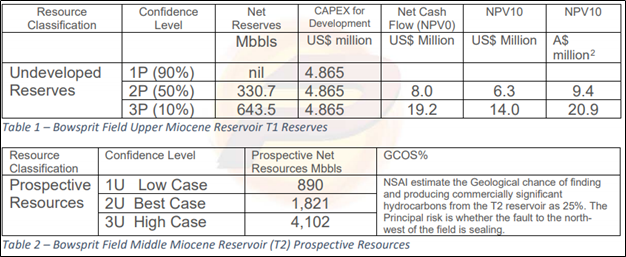
Source: PRM Report
Under the first phase, the Company plans to develop the T1 reservoir using one horizontal production well, which will consist of an initial vertical pilot hole drilled to 8,000 ft TVDSS. This vertical hole will evaluate the prospective resources and then plugged back. After this, the Company will undertake drilling with a deviation until the T1 reservoir is encountered with the well horizontal. PRM intends to place the well on production approximately 8 weeks after the drilling of the well.
Permitting of the pipeline routes are in progress and is expected to be in place within 3-4 months (April/May 2020). Meanwhile, the Company is currently in advance discussions with numerous parties potentially interested in farming into the project.
Moreover, with the NSAI Reserves Report endorsing the fact that the Bowsprit field has reserves, PRM has achieved a significant milestone, aiding the Company in concluding the farm-out process in February 2020 and selecting an optimum partner / funding option in respect of the Bowsprit well.
The stock of PRM last traded at $ 0.001 on 17 February 2020 with a market capitalisation of $1.32 million.
