AUS
AUS
 NZ
NZ
 UK
UK
 CA
CA
 USA
USA
 IND
IND







Summary
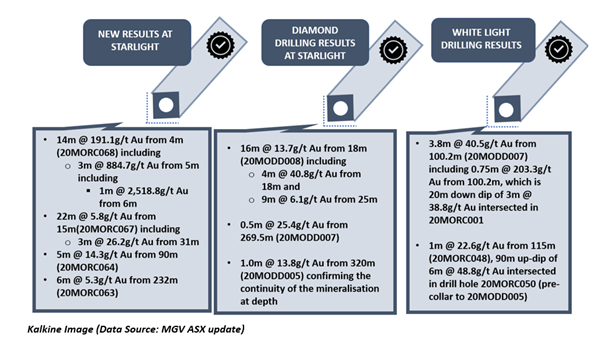
- Musgrave Minerals continues to witness high-grade gold discoveries at Starlight and White Light; all intercepts sit outside the existing resource base at Break of Day.
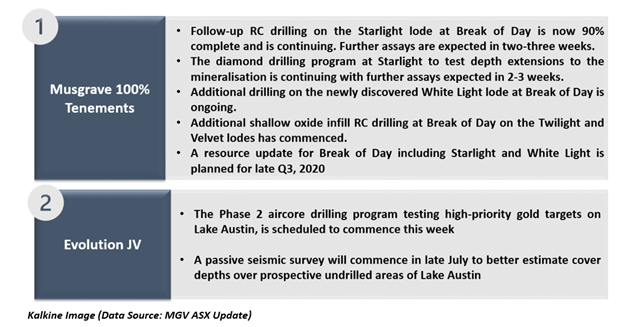
- Musgrave’s drilling program at Break of Day is focused on infilling and extending the mineralisation at Starlight, which would underpin the resource update at Break of Day late in Q3 2020.
- Diamond drilling is pursued along with RC drilling for testing the depth extensions of the Starlight mineralisation and further defining the White Light lode; assays are anticipated in the next 2-3 weeks.
- The new results from the Twilight lodes extend it around 60m south of the current resource estimate, while near-surface gold mineralisation is confirmed on the Velvet lode.
Australian gold explorer, Musgrave Minerals Limited (ASX:MGV) reports another set of high-grade gold results at the new Starlight gold discovery at Break of Day. Post announcing noteworthy drilling results from the current drilling program, MGV stock soared by over 7% to $0.740 on 28 July 2020.
ALSO READ: Musgrave’s Exploration Endeavours Hit Bonanza Near Surface Gold at Starlight, Stock Zooms Up
Notably, the impressive results came following the discovery of new White Light lode, which is 75m South of Starlight and strikes parallel to it.
Both the Starlight as well as White Light gold lodes at Break of Day are stationed at Musgrave’s flagship Cue Project, which is wholly owned by the Company and sits in the terrain of Western Australia (Murchison District).
Commenting on the recent results, Musgrave Managing Director Rob Waugh has indicated that further RC drilling is ongoing towards infilling and extending the mineralisation at Starlight, eyeing completion of a JORC resource update late in Q3 2020. Besides, diamond drilling is also being carried out in order to test depth extensions of Starlight lode below 250 vertical metres and for further defining the White Light Lode. He stated that the Company “anticipates having four drill rigs on the site by mid-August.”
ALSO READ: Musgrave's Robust Management Galvanising Exploration Endeavours
Lens through Robust Drilling Results
Musgrave reported assay results for a further five reverse circulation (RC) drill holes and the first five diamond drill holes from the current program carried at the new Starlight gold discovery at Break of Day.
From the RC holes drilled in the current program, the analysis of a combination of six-metre composites and one-metre individual samples have been done. The Company would resubmit all six-metre composite samples above 0.1g/t Au for individual one-metre sample analysis.
Significant new results from extensions to the Twilight and Velvet lodes at Break of Day include:
- 0.7m @ 34.1g/t Au from 65.1m (20MODD007)- Extends the Twilight lode ~60 metres south further than the current resource estimate
- 12m @ 6.4g/t Au from 40m (20MORC063)- The near-surface gold mineralisation confirmed on the Velvet lode
Ongoing Drilling Program
Program Focus
The drilling program targeted at infilling and extending the high-grade gold mineralisation is underway at the Starlight at Break of Day. Significantly, all the intersections returned from both Starlight as well as White Light lies beyond the boundaries of Break of Day’s current resource.
ALSO READ: Musgrave Minerals’ High-Grade Gold Resources Lobby A Golden Ticket to Noteworthy Achievements
Notably, Break of Day’s current resource estimate, which is 868Kt @ 7.2g/t Au for 199koz contained gold does not include any results from the new Starlight and White Light gold discoveries. Musgrave plans to update Break of Day’s Resource estimate in late Q3 2020, integrating the latest results from the Starlight and White Light gold discoveries
Furthermore, drilling for testing new lodes would continue within the mineralised corridor of Break of Day or Lena, with a third drill rig due to commence on the Company 100% owned ground in mid-August.
Drilling Progress
Up until now, Musgrave has completed 58 RC holes out of the planned 70 holes, while assay results have been received for 49 holes.
Additionally, to date, six deep diamond drill hole tails and three infill diamond holes have been completed, with assays received for five holes. Further assay results are expected within two-three weeks.
Way Forward