
 AUS
AUS
 NZ
NZ
 UK
UK
 CA
CA
 USA
USA
 IND
IND






Highlights
- Viking Mines shares rose ~7% following positive Linka Tungsten metallurgical results.
- Gravity separation delivered over 5,300% upgrade in tungsten mineralisation.
- The company produced a 63.7% WO3 concentrate at 42.4% recovery in initial testwork.
- Combined gravity and flotation recovery reached 83.8% of contained tungsten.
- The project demonstrates a low-CAPEX pathway using simplified processing methods.
- Further optimisation and drilling activities are planned for 2026.
Shares of Viking Mines Ltd (ASX:VKA) are in focus today, following the release of metallurgical testwork results from its Linka Tungsten Project in Nevada, USA, with the stock rising around 7.14% to AUD 0.015. The update outlines a potential processing pathway, with results indicating that the project’s mineralisation can be upgraded by over 5,300% using gravity separation methods. The announcement arrives amid elevated tungsten prices, with Ammonium Paratungstate (APT) nearing US$2,800 per mtu, while ongoing supply constraints and geopolitical developments continue to influence the broader market backdrop.
Julian Woodcock, Managing Director and CEO of Viking Mines Ltd, noted that this outcome highlights the company’s ability to produce a high-value, offtake-grade product without relying on complex or high-cost chemical methods, supporting a simplified flowsheet and potentially lower capital requirements. He added that further improvements in recovery are expected through flotation stages, while ongoing processing studies with Mineral Technologies are focused on defining a low-CAPEX development pathway aligned with current tungsten market conditions.
High-Grade Concentrate Achieved
Initial metallurgical testing has demonstrated the production of a high-grade concentrate. The company reported achieving a concentrate grading 63.7% WO3 at a recovery rate of 42.4% during its first cleaning attempt of gravity concentrate.
When combined with lower-grade middlings, the overall concentrate grade reached 56.4% WO3 with a recovery of 46.0%. Additional flotation testwork on gravity tailings further recovered 37.8% of WO3, lifting the combined recovery rate to 83.8%.
These outcomes are based on early-stage testing, with further optimisation work underway to refine both grade and recovery metrics.
Processing Pathway and Development Approach
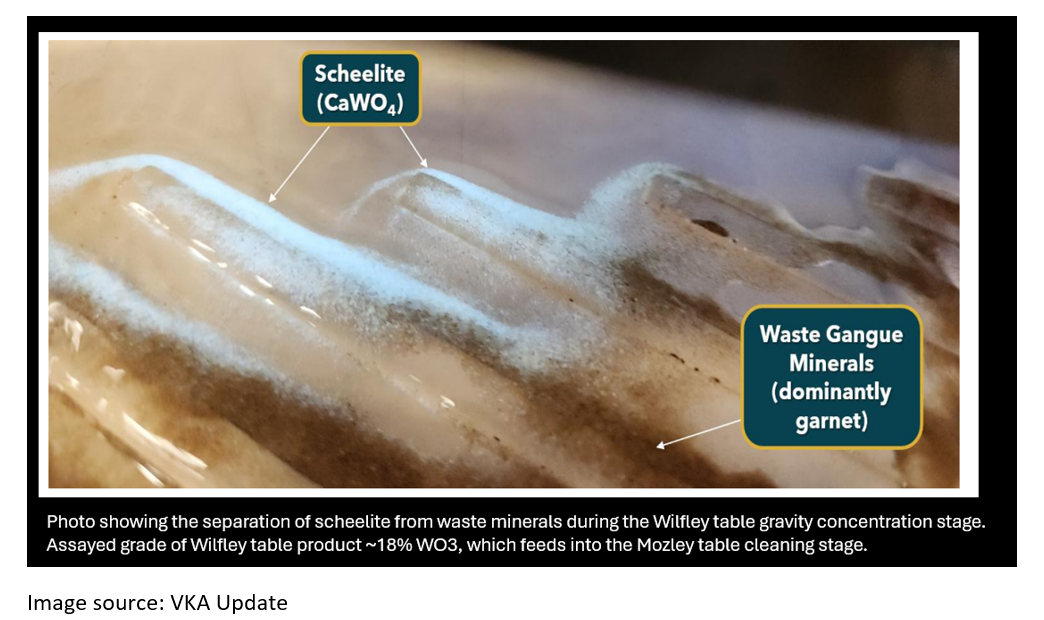
The company’s recent work has focused on validating a simplified processing model aimed at reducing capital requirements. Gravity separation has demonstrated the ability to produce a saleable concentrate without reliance on complex processing systems.
Peak concentrate grades of approximately 63.6% WO3 were achieved through gravity separation alone. This approach supports the concept of a modular processing facility that may require less time for development compared to conventional plants.
The testwork results are being incorporated into a conceptual processing study to assess plant design and capital expenditure requirements.
Recovery Profile and Operational Considerations
The results indicate that a portion of the tungsten mineralisation can be recovered using relatively simple methods. Initial gravity recovery reached over 40%, with combined recovery increasing when flotation is applied.
This staged recovery approach suggests that early production could focus on accessible material, with additional recovery phases introduced later to enhance overall output.
Flotation cleaning testwork has commenced to improve the grade of flotation-derived concentrates and further increase total recovery rates.
Testwork Progress and Technical Studies
The company has completed second-stage gravity separation and preliminary flotation testing. These tests confirmed the suitability of the mineralisation for gravity processing at a grind size of P100 250 microns.
Ongoing work is focused on refining the flowsheet, including improving both concentrate grade and recovery levels. Future testing will also examine coarser grind sizes and alternative processing techniques such as ore sorting.
In parallel, mineralogical studies are being conducted to better understand ore characteristics and support processing decisions.
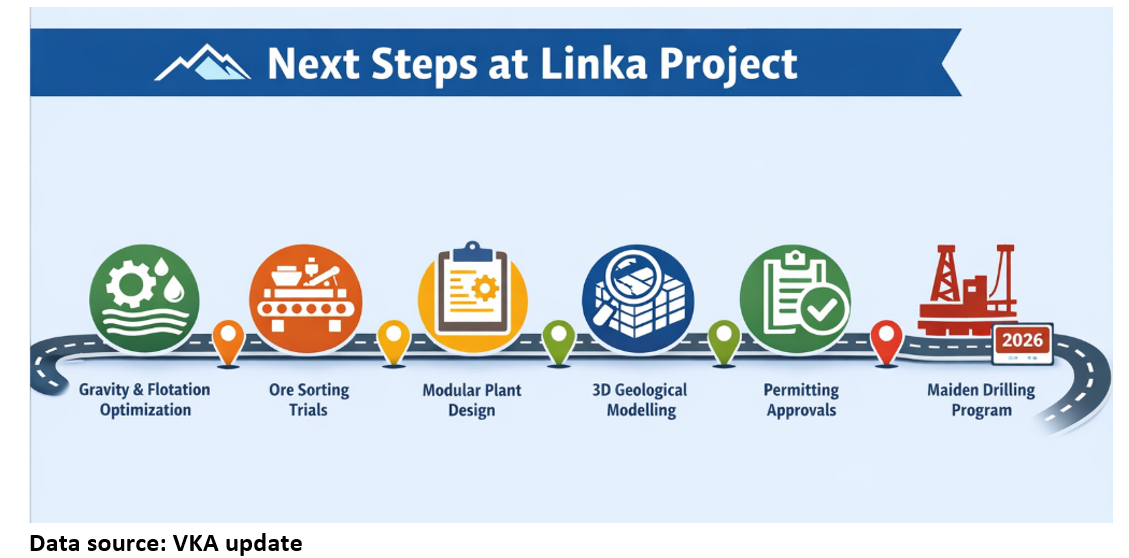
The company has outlined several steps for advancing the Linka Tungsten Project. These include continued gravity and flotation optimisation, ore sorting trials, and development of a modular processing blueprint.
Additional activities include scaling up testwork across multiple samples, completing a 3D geological model, and progressing permitting for drilling. A maiden drilling program is targeted for the June quarter of 2026, subject to approvals.
These initiatives are intended to support further evaluation of the project’s technical and development parameters.
