
 AUS
AUS
 NZ
NZ
 UK
UK
 CA
CA
 USA
USA
 IND
IND




_07_03_2026_03_50_21_133108.jpg)

Highlights
- At the Antimony Ridge Project, 3D modelling has defined more than 100 veins grouped into 30 mineralised zones across a 1,000m by 700m area.
- Historical and recent sampling confirm antimony grades exceeding 30% and silver values reaching up to 1,420 g/t.
- Inclusion in the FAST-41 initiative is expected to support faster permitting for drilling and bulk sampling programs.
- In May 2026, a major drilling program is planned at the Golden Gate Project.
Resolution Minerals Ltd (ASX:RML) (OTCQB:RLMLF) has released new findings from three-dimensional modelling at its Antimony Ridge Mine Project in Idaho, part of the Horse Heaven Antimony-Tungsten-Gold-Silver Project. The study has outlined the distribution of antimony and silver-bearing veins across a wide area, highlighting the scale of mineralisation within previously worked zones.
Large-Scale Vein Systems Outlined
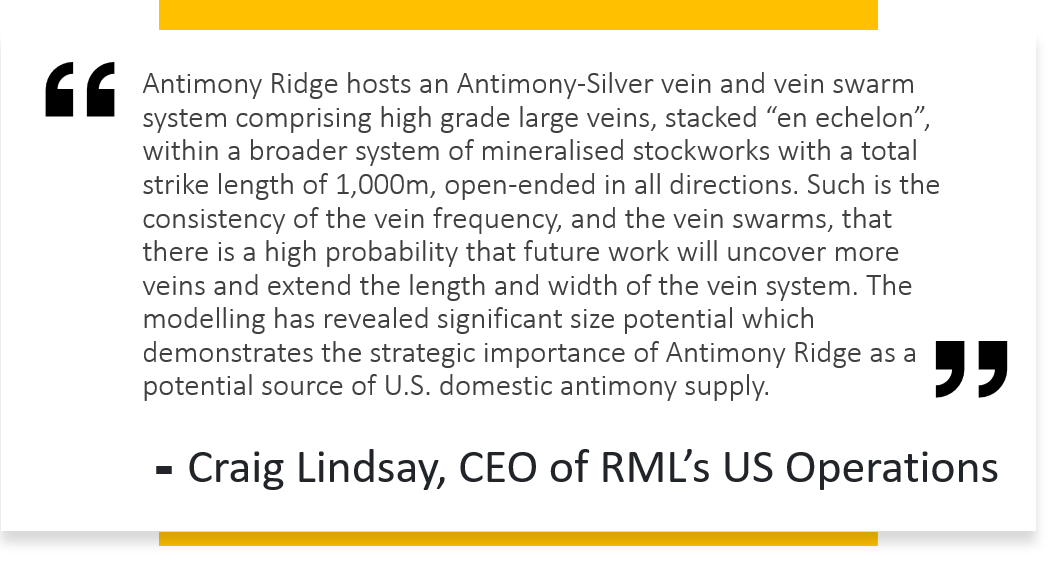
The three-dimensional modelling of multiple high-grade antimony and silver bearing veins, veins swarms and stockworks, over an area of 1000m x 700m at Antimony Ridge has highlighted a significant size and expanding scale potential.
The modelling showed that mineralised zones extend over approximately 1,000 metres by 700 metres, covering around 170 acres. The mineralised vein swarms are arranged in ‘en echelon’ clusters, with vertical continuity of up to 250 metres interpreted from exposed outcrops.
High-Grade Mineralisation Confirmed
The project area has a history of mining activity during World War I, World War II and the Korean War. These operations targeted antimony-silver veins that continue to show elevated grades based on modern sampling.
The reported results from the veins historically mined indicated antimony concentrations consistently exceeding 30%, with values reaching up to 50%. Silver grades have exceeded 250 grams per tonne, with peak values reported as high as 1,420 grams per tonne.
Multiple Vein Swarms and Mineralised Zones
Mapping and modelling have identified more than 100 individual high-grade veins, which have been grouped into 30 discrete mineralised zones of vein swarms, Sb-Ag veins, fault breccias and stockwork structures. Some veins are over 100 metres in length.
Exploration to date indicates that additional zones may be identified as work continues across the project area.
The high-grade vein swarm clusters and stibnite veins are enclosed within a broader halo of lower-grade Sb-Ag mineralisation. This halo, defined through soil and rock sampling, consists of veinlets and stockworks with antimony grades typically ranging between 0.5% and 2%.
Metallurgical Testing and Permitting Developments
Metallurgy test work is underway on a 100-kilogram mini-bulk sample of representative high-grade stibnite material, with results expected in the near term. Samples have been sent to different multiple organisations for a range of testworks.
The project has also been selected for FAST-41 Transparency Coverage by the U.S. Permitting Council. This designation is expected to support the advancement of permitting for future drilling and bulk sampling programs.
The company plans to conduct bulk sampling of high-grade antimony ore alongside a drilling program of up to 250 holes, subject to approvals. A Phase 2 campaign at the Golden Gate Project is scheduled for May 2026, including up to 45,000 feet of diamond drilling across 45 holes. The work aims to define gold and tungsten mineralisation and support a maiden resource estimate, with Antimony Ridge forming a key part of the broader Horse Heaven development strategy.
RML shares were trading at AUD 0.071 per share at the time of writing on 10 April 2026.
