
 AUS
AUS
 NZ
NZ
 UK
UK
 CA
CA
 USA
USA
 IND
IND






Highlights
- KRR has completed 942m of RC drilling across 13 holes at the Kurundi Gold Project, targeting extensions of high-grade zones and a new mineralised structure.
- Hole TTRC184 returned improved gold grades, indicating untested extensions north of Kurundi Main, with mineralisation remaining open at depth.
- Soil sampling at the Kuiper IOCG targets identified anomalies in key pathfinder elements, including a significant bismuth anomaly.
- Geochemical mapping confirmed iron-related signatures at Kuiper East and West, supporting the presence of IOCG-style mineralisation.
- KRR is preparing for the next phase of drilling at Kuiper.
King River Resources Ltd (ASX:KRR), an Australian gold exploration company, has made significant progress across its Tennant Creek Project in the Northern territory. The Tennant Creek tenements cover four main areas - Kurundi, Rover East, Barkly and Tennant East.
The company has focused recent exploration work on the Kurundi Gold Project and the Kuiper IOCG targets within the Tennant East Project area. These initiatives are part of its AUD 2 million exploration program, aimed at following up on targets generated from the company’s 2023 geophysics survey.
Kurundi Gold Project: High-Grade Zones and New Discoveries
At the Kurundi Gold Project, the company completed 942m of RC drilling across 13 holes in April 2025. The drilling focused on extensions of two known high-grade gold zones at Kurundi Main, as well as a newly discovered structure.
Encouraging assay results were returned from the new structure, including 4m at 1.43 g/t gold, with an interval of 2m at 2.79 g/t gold from 9m depth in hole TTRC188. The mineralisation on this structure remains untested along strike and at depth. The presence of historic alluvial gold workings in the area suggests the structure could host further undiscovered mineralisation.
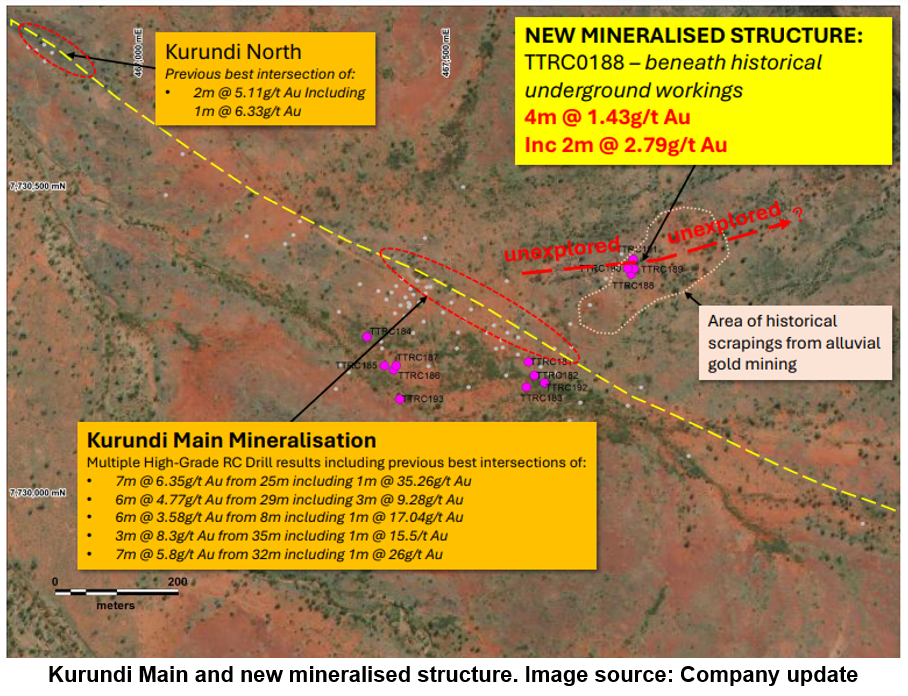
Drilling targeting the southern zones at Kurundi Main revealed structural complexity, including offsetting structures that may have displaced the main zone.
Drilling beneath the main mineralised zone followed up on 2024 results that intersected broad gold mineralisation with significant structure and veining. The new holes confirmed similar features, though without higher-grade intersections.
Notably, hole TTRC184 reported improvement in gold grades, suggesting untested extensions beyond historically drilled areas, open at depth and extending to the north of the main zone.
Kuiper IOCG Targets: Promising Soil Anomalies
In addition to gold exploration at Kurundi, the company advanced ionic leach soil sampling at the Kuiper IOCG targets. Key mineralisation pathfinder elements—Au, Cu, Bi, Ag and As—returned anomalies across the target areas, with several at Kuiper West aligning with interpreted folded hinge zones. Notably, a bismuth anomaly at Kuiper West closely coincides with the core of the gravity target, a significant finding as bismuth is an important feature often linked to Tennant Creek-style IOCG deposits.
Geochemical mapping of elements linked to magnetite and ironstones revealed clear trends corresponding with geophysically interpreted ironstone targets at both Kuiper Wast and East. These findings are highly encouraging, confirming the presence of key pathfinder elements and iron-related geochemical signatures. Together, the results strengthen the interpretation that the magnetic and gravity anomalies could represent IOCG-style mineralisation and might be linked with ironstones.
KRR plans to conduct the next phase of drilling at Kuiper.
King River Resources’ recent progress across its Tennant Creek projects highlights steady momentum in advancing both gold and IOCG exploration. The Kurundi drilling program has confirmed mineralised extensions and identified new structures with promising potential, while soil geochemistry and mapping at Kuiper continue to strengthen the case for IOCG-style mineralisation.
KRR shares were trading 7.69% higher at AUD 0.007 per share at the time of writing on 28 August 2025.
