
 AUS
AUS
 NZ
NZ
 UK
UK
 CA
CA
 USA
USA
 IND
IND






Highlights
- Haranga’s maiden drilling has confirmed near-surface mineralisation, following completion of drilling at the Ibel South Gold Project in July.
- A total of 2,000 metres of AC drilling completed across four lines, targeting termite mound gold anomalies and artisanal workings.
- Drilling suggests lateral mineralisation continuity over 700+ metres with potential for further strike extensions.
- Geological observations indicate similarities with regional mineralised lithologies, including silicified greywacke with quartz veining and sulphides.
- Haranga Resources’ share price jumped 27% on 10 September to AUD 0.110 per share during morning trading.
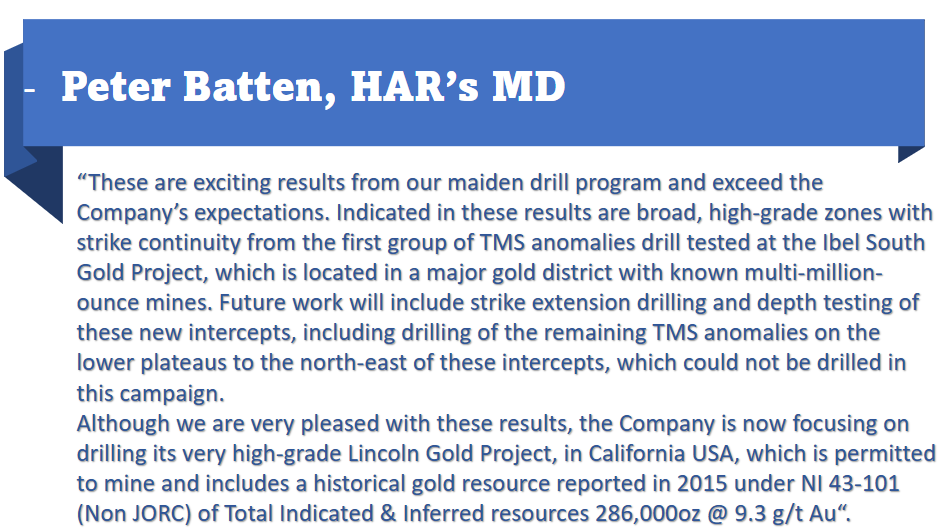
Haranga Resources Limited (ASX:HAR) (FRA:65E0) has released encouraging results from its maiden aircore drilling program at the Ibel South Gold Project in southeastern Senegal. The program, completed in July 2025, comprised 2,000m of drilling across 41 holes and successfully confirmed gold anomalism, previously identified through termite mound sampling (TMS).
Select assays have confirmed broad, shallow and high-grade gold intersections, including:
- 25-IBS-AC-008: 20m @ 6.54 g/t Au from 12m, incl. 4m @ 14.64 g/t Au
- 25-IBS-AC-016: 10m @ 6.35 g/t Au from 44m, incl. 6m @ 8.55 g/t Au - (Hole ended in mineralisation)
- 25-IBS-AC-017: 4m @ 14.83 g/t from 8m,
- 25-IBS-AC-007: 4m @ 4.92 g/t Au from 4m,
- 25-IBS-AC-010: 8m @ 1.58 g/t Au from 24m,
- 25-IBS-AC-005: 12m @ 1.30 g/t Au from 32m, incl. 4m @ 1.96 g/t Au,
- 25-IBS-AC-011: 28m @ 0.82 g/t Au from 16m, incl. 4m @ 2.68 g/t Au
Expanding Potential Across Strike
The drilling indicates that mineralisation extends laterally for more than 700m, with potential for a greater strike length if zones connect. Drill logging revealed 4–8m of laterite overlying deeply weathered saprolite up to 50m thick. Below this sequence, drilling intersected altered sedimentary units, including a silicified greywacke horizon hosting quartz veining and visible sulphide mineralisation, notably pyrite and arsenopyrite.
Drill Collar Placement and Campaign Efficiency
Drill collars were positioned to reduce environmental impact, ensuring safe access and avoiding major vegetation. Collar positions were restricted to the top of the plateau due to seasonal weather constraints, as the rainy season prevented access to slopes and sub-plateau areas. Consequently, several large termite mound gold anomalies located to the west and north were not tested during this campaign and remain open for future exploration.
Despite these limitations, the program was completed ahead of schedule, wrapping up within just ten days through double-shift drilling. Notably, the campaign successfully penetrated the thick laterite cover and saprolite zones to reach fresh bedrock across multiple holes.
Next Steps
Re-assaying of Samples - The company’s immediate priority is to re-assay the original 1m samples from all composite intervals that returned gold grades above 0.25 g/t. This process will help refine the mineralised boundaries and confirm internal grade distribution. The selected samples are currently being sorted and will be sent to the laboratory without delay.
Comprehensive Data Interpretation - The full assay dataset will undergo detailed interpretation, once all assays are received.
The company plans to integrate multi-element results, portable XRF data, geological logging, and geochemical analysis to build a more comprehensive understanding of the mineralisation. This approach will assist in defining the next phase of drilling targets, aimed at testing both depth and strike continuity of the zones identified in the maiden campaign.
Results from this analysis are expected by the end of September.
Field Operations Timeline - After the wet season, field operations are expected to resume, with exploration activities anticipated to recommence in the fourth quarter of 2025.
Haranga Resources’ share price surged by 2.04% on 12 September to trade at AUD 0.100 per share.
