
 AUS
AUS
 NZ
NZ
 UK
UK
 CA
CA
 USA
USA
 IND
IND

.jpg)




The Accord de Paris limits the increase in global average temperature to well below 2 degrees Celsius and further striving to limit it to 1.5 degrees against pre-industrial times.
An important question arises, How could it be achieved? Though, 195 signatories agreed and many of economies are ratifying the agreement.
One such solution is switching to Electric Vehicles from the current fossil fuel run vehicles.
These Electric vehicles rely on electrical power to run their vehicles and therefore help reduce the emissions. But, again there arises an important question that needs to be addressed-
Do we actually have the demand and are their suppliers of the battery techs?
This question is significant to answer given many of the global leaders have long declined the climate change phenomenon and also criticised the requirement of electric vehicles.
Today, we will look on the some of the biggest EV producers, the demand setters as we say-
Tesla
Tesla produced over 415,000 vehicles in 2019 experiencing strong revenues from Model S, X & 3.
Tesla has operational facilities in Fremont in the US & Shanghai (produces only Model 3 for now) in China. Other car producing facilities in Berlin & North America are currently under development.
By mid of 2020, Tesla is set to enter the crossover market with the Tesla Model Y. It’s also setting up facilities to produce the model Y from its Fremont and Shanghai plants. The company has the capacity to use the current global annual supply of Li-ion batteries.
It is ironical that the first Fremont factory was actually home to General Motors (1962-82) and GM Toyota (1984-2009), the top two ICE vehicle players in US. Tesla on remodelling the facility is set to extend the Fremont capacity to 5,00,000 vehicles by mid-2020 with the addition of Model Y.
Tesla currently produces its batteries through its JV with Panasonic for its vehicles at the Gigafactories.
BYD Group, the Chinese EV maker has now expanded its market geographies to other regions of the world. BYD signed the largest EV bus sales deal in Europe and already has the largest fleet of electric bus in the US.
BYD has also launched the EV dump trucks and bets big on the large commercial segment.
In comparison to a diesel power vehicle, each BYD bus expects to reduce the emission by an annual average of 15.5 tonnes of NOx and 32.2 tonnes of CO2.
BYD sold approximately 2,20,000 electric vehicles in 2019 and still remains one of the biggest players in Chinese and Global EV markets.
BYD group has also diversified into the manufacturing of Battery packs and photovoltaics industry (11.4 capacity at the end of H1,2019).
Since, we saw the major demand setters, we also need to see if there are suppliers for the battery packs or not. Here are a couple-
Contemporary Amperex Technology or CATL is one of the world’s largest battery manufacturer in China.
CATL, headquartered in Ningde, China was founded in 2011 focuses on development, production and sales of EV, energy storage battery systems and the Lithium-ion battery cathode material supply. NATL includes three manufacturing facilities along with two R&D centres in China and Germany.
In 2019, CATL began the production of NMC (811) batteries for the BMW X1 PHEV model. The entry into the NMC segment might open future doors of diversification into other popular battery compositions such as NMC (523) and NMC (622) batteries.
CATL holds interests in the HPAL nickel Project in Indonesian Morowali Industrial Park, Indonesia and recently, signed an agreement for picking up 8.5% stake in Australian Lithium miner, Pilbara Minerals Limited. CATL holds a capacity of 40 GWh per year of lithium ion battery, with 30 GWh/yr battery plant in Yibin under construction and 100 GWh/yr battery factory planned in Germany by 2025
CATL supplies its battery packs to the leading global EV producers including Toyota, BMW, Volkswagen and Honda. CATL recently, signed a supply agreement with Tesla for battery packs effective between July 2020 & June 2022.
LG Chem was founded in 1947 and later, in 1999 entered the LI-ion battery commercial market, today is one of the largest producers of battery. LG chem realised a sales worth 8.4 trillion Korean won in FY2019 from its Energy Solutions, a ~29% growth y-o-y, backing on the increased demand from the electric vehicles. The company expects to double its revenues from the energy solutions to 15 trillion Korean won.
LG chem owns several R&D Centres including one at Daejeon, Korea and 4 manufacturing plants located in Michigan in US, Nanjing in China, Ochang in Korea and Wroclaw in Poland.
The company produces energy storage, automotive and IT & appliances batteries
The revenue enhanced with the expansion of sales in EV batteries to European Market
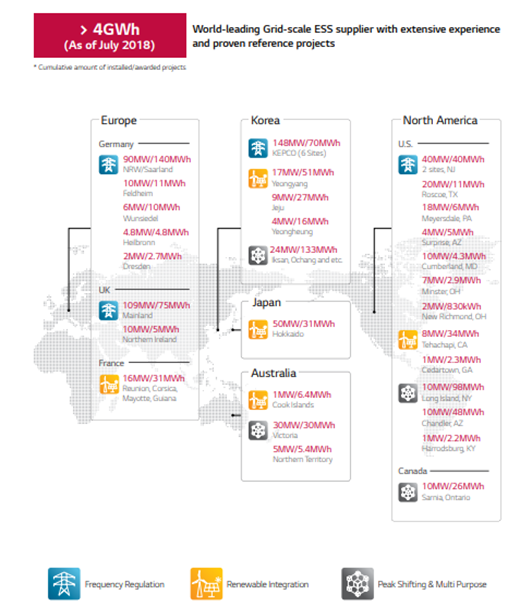
LG Chem ESS Projects Source: LG Chem
New Wroclaw Manufacturing facility
The European Union aims to become a carbon neutral society by the year 2050 and rising EV adoption rates as a result of the competitive targets and reforms by the government to curb against the rising emissions and also achieve the competitive targets by the EU and under the Paris accord.
The €2.8 billion Wroclaw plant is expected to reach the final capacity of 65-70 GWh a year by 2022, producing almost 1 million electric vehicles per year (~6% of the yearly automotive sales) , resulting in the reduction of almost a million tonnes of CO2 emissions every year.
The only fully integrated plant facility in EU to deliver battery components, varying from cells to electrodes, and final packs & modules will produce LI- batteries for EV’s.
LG Chem has a current capacity of ~70 GWh and is slated to increase to 100 GWh by 2020.
LG Chem & its American dream
The US EV market is growing at an annual growth rate of 26% and is expected to grow to 1.32 million cars in 2023.
LG chem inked a 50-50 JV with US largest carmaker General Motors to set up their own version of Gigafactory in Lordstown, Ohio to procure production capacities upwards of 30Gwh by 2023.
Though the entire EV landscape is vast, but we cannot deny the increasing adoption of EV in the current scenario. The next question in my mind arises about the Total Cost of Ownership of an EV in comparison to an ICE vehicle & average Emission reduction for a pedestrian Australia by switching to an EV. We promise to get back with the solution to the puzzle.
Also, we need to look into what plays a major role in the manufacturing of the battery packs-
Yes, you guessed it right, its mining commodities which together are often termed as Battery materials such as Lithium, Cobalt, Nickel & Graphite. One need to be thorough with the market dynamics of these commodities to accurately forecast the future of the EV & Battery market.
