
 AUS
AUS
 NZ
NZ
 UK
UK
 CA
CA
 USA
USA
 IND
IND

_12_19_2022_14_47_44_164716.jpg)





Highlights:
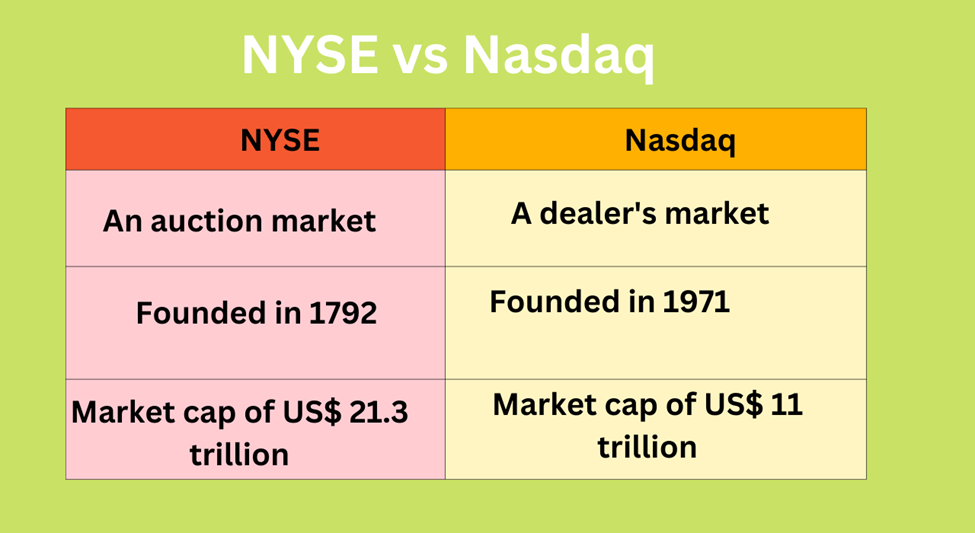
- NYSE was founded in 1792.
- NASDAQ was founded in 1971.
- NYSE is an auction market, while NASDAQ is a dealer’s market.
Whenever someone broaches the topic of the US stock market, two names that immediately come to mind are NYSE (an acronym for New York Stock Exchange) and Nasdaq. These two are the two exchanges that share most of the bulk stock trading in the US and globally too.
However, they have some basic differences regarding how they operate and the stocks they list. Here we will delve into a few differences between NYSE and Nasdaq:
A brief history of NYSE:
The oldest American stock exchange, NYSE, was founded way back in 1792 on May 17, when a congregation of 24 stockbrokers at 68 Wall Street signed a pact. The first company that got listed on NYSE was the Bank of New York. It ran for more than 200 years as a member-owned not-for-profit corporation. It went public on March 8, 2006, taking the ticker NYX. The company was finally taken over by its current parent company ICE (Intercontinental Exchange Inc.) in 2013.
A brief history of Nasdaq:
Nasdaq is the world’s first electronic marketplace for trading securities. It is headquartered in New York. Nasdaq was formed in 1971 as a subsidiary of FINRA (Financial Industry Regulatory Authority). It was from February 9, 2005, Nasdaq began to trade on the Nasdaq stock market after offering secondary shares
What are the differences?
There is a difference between the two in how they match buyers and sellers. Nasdaq’s modus operandi is using a dealer’s market. In Nasdaq buyers and sellers do not transact between them but through an intermediary.
However, NYSE is different. There are no intermediaries for NYSE. It operates through an auction market. Individual investors are matched using the auction system. The highest bidder is then matched with the seller with the lowest quote.
 Source: ©Kalkine Media®; © Canva via Canva.com
Unlike NYSE, Nasdaq has been a for-profit organization since its inception. In terms of tenure, Nasdaq is not as old as NYSE.
The market capitalization of the Nasdaq is US$ 11 trillion, while the NYSE has a market cap of US$ 21.3 trillion.
NYSE had around 2800 companies trading on its platform, while Nasdaq had over 3,300 companies under its fold at the time of writing.
The two differ in terms of listing. To get listed on Nasdaq, the companies must have a minimum of 1,250, 000 shares made available to the public, while NYSE-listed companies should have issued at least 1,100,000 shares to the public to trade. There is also a difference in the fee structure between the two exchanges. Investors on NYSE must pay an entry fee of up to US$ 500,000, while the entry fee on Nasdaq ranges from US$ 50,000 to US$ 75,000.
Bottom line:
Despite the differences between them, both NYSE and Nasdaq are equally important exchanges in the world. Stockbrokers from both exchanges allow people to trade on each other’s platforms.
