
 AUS
AUS
 NZ
NZ
 UK
UK
 CA
CA
 USA
USA
 IND
IND






Summary
- Asda Ltd is the second retailing company in the United Kingdom after Sainsbury Plc to pledge to be carbon neutral by the year 2040.
- The company has also announced that it would halve its wastage by no later than 2050, which would have a regenerative impact on nature.
- Marks & Spencer Plc has maintained a carbon-neutral global operation since the year 2014
One of the largest retailing and supermarket chain company in United Kingdom Asda Ltd has announced that it would be achieving " Net Zero" carbon emissions levels by 2040. This pledge also came with the additional pledge that the company will also be striving to cut down its wastage by fifty per cent by no longer than 2050.
It is to be noted here that people in the United Kingdom have been increasingly becoming concerned about the urgencies of climate change and have been putting pressure on corporates to do put more efforts to lessen their carbon footprint.
The rival retailer, Sainsbury Plc, had some time back also pledged to spend £1 Billion to achieve a " Net Zero" carbon emission target by 2040. Tesco Plc, on the other hand, has made a pledge to halve its food wastage by fifty per cent by the year 2030, though it has not made any firm commitments on the " Net Zero" carbon emission front.
Commitments on the carbon emission front
Reducing the carbon footprint is a major objective that has been set out by many companies in the past few years in their pledge to do more for the protection and preservation of the environment. Sainsbury Plc in the month of January this year had announced that it had pledged £1 billion in spending to make itself carbon neutral by 2040. The company has made this commitment after having made efforts and reducing nearly 35 per cent of its emissions, over a fifteen-year period.
Tesco has a pledge to halve its food waste by the year 2030, for which it has initiated an experiment whereby it will try to inculcate responsible behaviour among its customers regarding food waste. The experiment which will run for six-weeks is aimed at reducing the annual household food wastage of the country, which runs to around 6.6 million tons.
Marks & Spencer Plc has maintained a carbon-neutral global operation since the year 2014; the company has a further target of achieving 90 per cent absolute emission reduction by 2035.
Supermarket companies like Sainsbury’s Plc, Tesco Plc, Marks & Spencer Plc and Asda Ltd have a huge impact on the way its individual customers use their products and can be a great influence in helping more and more people adopt a healthier and carbon-neutral way of life.
Efforts being made by the British government
While the United Kingdom was a part of the European Union, it had been part of several environmental regulations been brought in by the European Union to bring about environmental degradation effects in control. Among the most important regulations that have been brought in are the individual country requirements that now rests on countries to reduce the carbon footprints.
On the corporate sector side, regulations have been put on the automobile sector to increasingly produce vehicles with low carbon emissions and to eventually move out of Internal combustion technology for transportation and stop using petroleum using engines at all.
More and more emphasis is now being put on electric vehicles with power sourced from renewable resources. Utility companies in the United Kingdom and elsewhere in the European Union are also being asked to increasingly source their energy requirements from renewable resources and shun the use of coal, crude and gas for energy production.
The steel sector, cement sector and thermal energy sector which use significant amounts of coal are now being asked to substitute or significantly reduce their use of coal or attract significant penalties. The Airline industry is also not being spared, the industry being the one that emits carbon dioxide and other derivatives greenhouse gases in the upper reaches of the atmosphere are now facing regulations to improve their performances on this front. The coal and oil companies in the continent are also facing a lot of discontent from the non-governmental organisation and government to reduce their carbon footprints as well.
The stock price performance of Sainsbury Plc
J Sainsbury PLC (LON: SBRY) one of the largest supermarket operators in the UK, is present in General Merchandise, Clothing, Retail Food, Financial Services as well as Property Investments business segments.
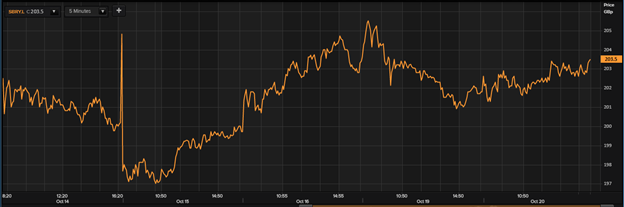
(Source- Thomson Reuters)
As on 20 October 2020, the shares of J Sainsbury PLC have been trading at GBX 203.50 per share (3.57 PM GMT+1) gaining 0.72 per cent over previous day’s close.
The stock price performance of Tesco Plc
Tesco Plc (LON: TSCO) is the largest grocer and supermarket chain operator in the United Kingdom. The company is also the third-largest retailer in the world having a presence in seven countries across Europe and Asia.
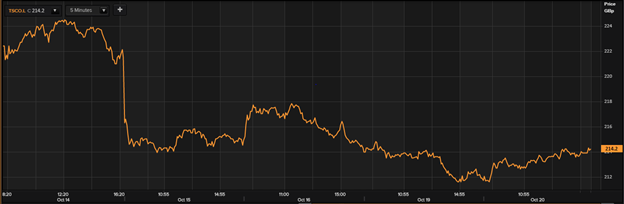
Source- Thomson Reuters
As on 20 October 2020, the shares of Tesco Plc have been trading at GBX 214.20 per share (3.58 PM GMT+1) gaining 1.31 per cent over previous day’s close.
The stock price performance of Marks & Spencer Plc
Marks & Spencer Plc (LON: MKS) is a United Kingdom Headquartered multinational retailing company and one of the most recognised brands in the UK having strong brand loyalty.
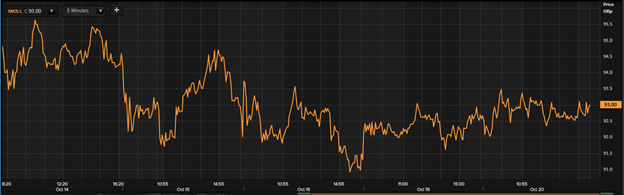
(Source- Thomson Reuters)
As on 20 October 2020, the shares of Marks & Spencer Plc have been trading at GBX 93.00 per share (4.00 PM GMT+1) gaining 0.41 per cent over previous day’s close.
