
 AUS
AUS
 NZ
NZ
 UK
UK
 CA
CA
 USA
USA
 IND
IND







Since almost 80 percent of Britain’s dairy exports went to the EU, post Brexit, it was decided by the government to strengthen the industry with measures that would boost its productivity and cost competitiveness. But while we were at it, a new supply chain disruption came in the form of Corona induced lockdown, which the dairy sector is now battling with.
Dairy trade came to a standstill with government induced restrictions in place. With dwindling demand, few milk processors even started offering milk free of cost; they were asking retailers to only bear the cost of transportation. Also, there are some producers who are left with no option but to dump milk on the farms. The foodservice market is at a complete loss, with most restaurants, cafes and retail malls closed due to the lockdown.
UK’s Dairy industry and its economic significance
The dairy industry is immensely important to the growth of Britain’s economy. Milk accounts for 17 percent of the total British farm output. UK is the 11th largest milk producer and 10th biggest exporter of milk globally. Dairy farms and processing units collectively employ more than 75,000 people. The main constituents of the country’s dairy industry are fresh milk, cheese, butter, cream, powder milk, buttermilk, whey and yoghurt. Almost every UK home consumes milk and yoghurt, while more than two-thirds of the population eat cheese.
The wholesale milk production for the UK was close to 1300 million litres in March 2020.
United Kingdom wholesale milk production (million litres)
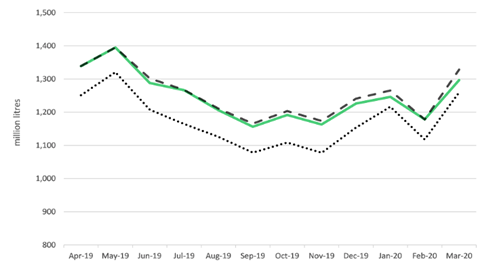
(Source: National Statistics, Government of UK)
British dairy products are also exported to the EU and other countries. Almost 20 percent of the raw milk produced in Britain is exported, demonstrating the industry’s global competitiveness.
Not being self-sufficient in all dairy products, the country also imports them.
Exports and imports of dairy products showing a varied picture
Despite the fact that the UK exports a sizable volume of dairy items, it surprisingly does not have a dedicated dairy industry export association. Maybe it is the need of the hour to build the British brand.
During Q1 2020 (January till March), the exports of ‘yoghurt’ and ‘whey products’ rose by 43 percent and 11 percent respectively, over the same quarter last year, as per IHS Maritime & Trade Statistics.
While for the other three main dairy product categories, the quarterly exports have fallen significantly. For ‘butter & dairy fats’, ‘milk powders & concentrates’ and ‘cheese & curd’ groups, Q1 2020 exports fell by 25 percent, 16 percent and 14 percent respectively.
Imports of all these daily categories are also down, except for yoghurt, whose imports grew by 3 percent in Q1 2020, over Q1 2019. Imports for ‘whey products’, ‘milk powders & concentrates’, ‘cheese & curd’ and ‘butter & dairy fats’ were down by 32 percent, 21 percent, 21 percent and 11 percent respectively in Q1 2020, over the same quarter the previous year.
The latest trade statistics for April 2020 are awaited and will tell the exact extent of impact felt by the dairy industry due to the lockdown imposed to suppress corona infections across the nation.
Domestic prices on a downward pressure with corona disruptions
The fact that both imports and exports are down for most of the categories does indicate a need for a closer look at domestic production as well as consumption of dairy items in the United Kingdom. This time of year, there is usually a rise in dairy produce, coupled with a sharp drop in demand due to retail chain disruptions, this translates into a downward push on the prices.
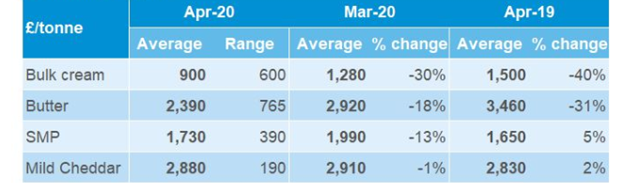
UK Wholesale Prices
(Source: Agriculture and Horticulture Development Board, UK)
The Agriculture and Horticulture Development Board (AHDB) has compiled few stats in discussion with dairy producers, traders and buyers. According to it, the UK dairy wholesale price statistics for the month of April 2020 reveal a fall across bulk cream (by 30 percent), butter (18 percent), skimmed milk powder (13 percent) and mild cheddar (1 percent) categories, as compared to the earlier month on March 20. Bulk cream and butter figures were lower by 40 percent and 31 percent respectively, when compared to last year’s data (for April 2019). Wholesale prices for SMP and mild cheddar were up by 5 percent and 2 percent respectively since a year back.
As per AHDB data, overall, more than 50 percent of farmers have suffered from a fall in milk prices during April 2020, mostly ranging between 0.5ppl to 4ppl. The total loss in this month to the dairy farmers is valued at £9.4 million. AHDB and Dairy UK are contemplating ways to temporarily reduce the production and stimulate demand for dairy products.
Supply chains throughout the dairy chain were interrupted since March 2020 due to the corona-induced lockdown. These vulnerabilities have clearly impacted the dairy farmers, and they are worried about how to take their products to the consumer, in this new scenario. They fear about how to cope with a considerable price drop if this trend continues. According to expert estimates, more than 10 percent of milk producers are severely affected with either order cancellations, payment delays or have even been asked to lower their output.
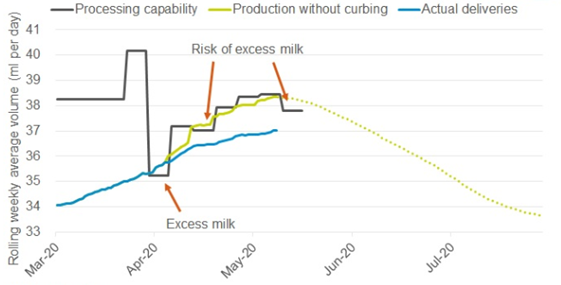
Great Britain milk production versus processing capability
(Source: Agriculture and Horticulture Development Board, UK)
The AHDB data reveals that milk deliveries for May 2 to 9, 2020 were averaged at 37 million litres per day. With farmers trying to curb milk production, the risks of milk exceeding processing capacity are being mitigated. If the production takes place without curbing, there is a risk of excess milk production.
Is there any Government support coming in?
The government is allocating a collective fund of £25 million to provide the much-needed support to the dairy and beef sectors in the United Kingdom.
The Farming Minister Edwin Poots says,
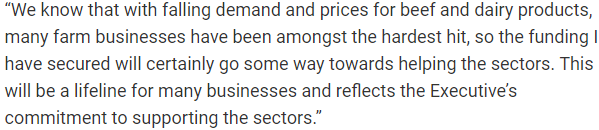
Farmers unions’ in Britain had been longing for this aid to support the farming families under distress.
The British government also announced a relaxation under the country’s Competition Law for the dairy industry on May 2, 2020. Under this relaxation, certain kinds of cooperation between dairy produce suppliers, like milk production and demand estimates, is being allowed to resolve corona led supply chain concerns. The relaxation is valid for three months.
Amidst uncertainties, Arla Foods UK plc (LSE:ARU), the leading milk producer in Britain announced on April 23, 2020 that beginning May 1, its milk prices will be lowered by one-euro cent to 29.89p per litre.
On the other hand, the British dairy farm cooperative firm First Milk felt that their model could withstand the corona storm better and announced holding back its member milk prices at an earlier level of 26.75ppl for each liquid standard litre of milk, but did admit that over time, they also can’t guarantee remaining insulated from the overall condition of the dairy industry.
To sum up, only the challenging times ahead could speak about the continuing corona impact to the UK dairy sector, even after the easing down of the lockdown restrictions.
