
 AUS
AUS
 NZ
NZ
 UK
UK
 CA
CA
 USA
USA
 IND
IND






Summary
- On 21 September 2020, Victoria registered fewest single-day rise since 14 June, recording just 16 new COVID-19 cases in the state with many facilities to reopen from 28 September if the 2-week average number of cases is below 50.
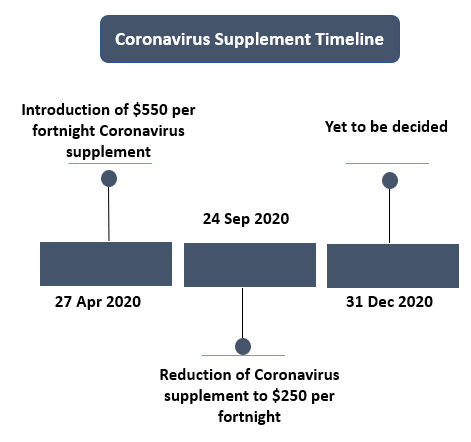
- The $550 per fortnight coronavirus supplement will be subject to stricter conditions and is now being cut back to $250 per fortnight from 25 September and will be available till 31 December 2020.
- The unemployment rate in Victoria increased to 7.1% in August, while it declined for the rest of Australia to 6.8% from 7.5% in July.
- Cutting back coronavirus supplement will lower the size of the economy by $31.3 billion and cost 145,000 full-time jobs over 2 years, as per Deloitte.
The state of Victoria has been under one of the toughest lockdowns, after a resurgence of the virus, which took the daily case numbers to hit more than 700.
However, Victoria recorded just 11 new cases of coronavirus, the smallest daily rise in infections in more than 3 months and 2 deaths on 21 September. On 22 September, there were 28 new cases of coronavirus detected.
Victoria is now on track to meet the condition of maintaining 2-week average cases being less than 50 for reopening of building sites, warehouses, manufacturing units and childcare facilities from 28 September.
Majority of restrictions in Victoria will be relaxed by late October if the 2-week average is less than 5 cases.
JobSeeker changes coming up
The Federal Government is set to cutback the $550 coronavirus supplement for JobSeeker recipients to $250 from 25 September. The $550 supplement doubles the JobSeeker to $1115 a fortnight for a single person, sans any dependent, which includes a fortnight base rate of $565 and $550 as a top-up payment called coronavirus supplement.
DO READ: Is Australia ready for the JobSeeker cord being pulled?
Now as the supplement has been cut back to $250, the JobSeeker payment for singles is at $815 every fortnight. The drop in the supplement does not just affect JobSeeker recipients; it also results in a fall in other government payments, including Austudy, Youth Allowance, and Farm Household Allowance.
Further, the Government has also relaxed the criteria for both JobSeeker and Youth Allowance to help people earn more money without affecting their payments. The income-free threshold for both the payments will also rise to $300 per fortnight from 25 September while assets limit will be reinstated.
The Government is also hardening the mutual job obligation requirements for JobSeeker recipients implying that people will have to look for 8 jobs every month from 28 September from the current 4 jobs a month since early August. However, mutual obligation changes will not apply to Victoria.
ALSO READ: Morrison government revamped rules lets one take a dip into JobKeeper and JobSeeker dole outs
However, Treasurer Josh Frydenberg declared that JobSeeker changes would not be applied to Victorians after the state lost 42,000 employment in August. He added that the Australian Government had infused more than $28 billion to stimulate the economy of Victoria.
The economic cliff will hit Melbourne hard
The number of people getting income support payments doubled between December 2019 and May 2020, rising from 820,000 to 1.6 million. The main reasons for the increase included social distancing measures, coronavirus pandemic and restrictions on businesses and services put by the Australian Government and subsequent job losses.
DO READ: 5 Steps Australia should take as the business re-opens across Victoria
Treasury analysis showed that the number of unemployment benefit recipients in Victoria increased by about 27,600 or 7.2% since 26 June, with more than 50% of it happened in 3 weeks ending 21 August.
Emma King, Chief Executive of Victorian Council of Social Services (VCOSS), stated that the cuts would be devastating for Victorians in these challenging times and the present rate of coronavirus supplement ($550) must continue in all states in crisis.
Victorian unemployment rate rising
As per ABS, the official unemployment rate for the country fell to 6.8% in August from 7.5% in July, but things remain challenging for people who are without work amid lockdown in Victoria.
ABS figures showed that despite stage 4 restrictions in Melbourne and stage 3 restrictions in regional Victoria, about 111,000 jobs were created in the country, but 42,400 jobs were lost in Victoria.
ALSO READ: Victoria’s second wave of COVID-19 is pulling down jobs and consumer spending
Victoria witnessed a drop in the employment of 1.3% and was the only state that did not show any signs of recovery, as per the official employment figures.
Must watch: Increased Unemployment, and decline in Property prices in Australia? | Market Update
ABS data verified that Melbourne is now the nerve centre of the unemployment crisis of the country after a resurgence of the virus and tough lockdown in August, which is creeping through September also.
The overall unemployment rate in Victoria increased to 7.1%, up from 6.8% in July. Further, hours worked declined by 4.8% in Victoria compared to a 1.8% rise in the rest of the country.
Cost to the economy
As per a report by Deloitte, the reduction in $550 coronavirus supplement will not only hamper the economic recovery of the country, but also decrease both GDP and employment across Australia.
Lower supplement amount will reduce the size of the economy by $31.3 billion and will cost about 145k full-time jobs across 2 years period.
INTERESTING READ: Second Page of the COVID-19 Diary: Business Insolvencies, Unemployment, Underemployment
The firm estimated that the number of people receiving the coronavirus supplement would peak at 2.34 million in December when the unemployment rate reaches 10% and dropping to 1.73 million recipients by June 2022.
ALSO READ: Withdrawal of Wage Subsidy Packages early can bog down Australian economy
The supplement, is due to end in December, covers income benefits for nearly 2.3 million individuals, together with those receiving Jobseeker payments, students, and parenting payments.
(NOTE: Currency is reported in AU Dollar unless stated otherwise)
