
 AUS
AUS
 NZ
NZ
 UK
UK
 CA
CA
 USA
USA
 IND
IND

.jpg)




Highlights
- Carbon Tax is a tax levied on the businesses that produces carbon dioxide (CO2) and other harmful gas through their operations.
- The government sets a price that emitters have to pay for each ton of greenhouse gas emission, which help in reducing the emissions, as the companies will try to avoid the tax.
- Experts have proposed an international tax on carbon to ensure that companies cut its carbon emission.
Carbon pricing is a raging topic all over the world. The carbon pricing is basically pricing the emissions of greenhouse gases (GHGs), essentially estimating the costs of climate change and the damages that should be put on producers and customers so that they are forced to reduce emissions.
The metal industry is one of the largest carbon emitters in the world, but cutting the emission is nearly impossible. According to the World Steel Association, steel industry accounts for about 8% of global carbon emissions.
Martin Pei, the head of the Europe’s leading steel producers SSAB, has called for an international tax on carbon to ensure that companies cut its carbon emission but warned against greenwashing.
To cut the emission, SSAB plans to produce 1.5 million tonnes per year of fossil fuel-free steel by using electricity to produce hydrogen by splitting water molecules by 2026. However, the government support is needed to cut carbon emission by setting a price on each tone that businesses emit. It will help climate mitigation efforts and allow business to go green.
On the sidelines of the Cop26 climate summit, Pei said that various attempts to claim steel is green is nothing but branding. He claimed that the companies are not doing anything, just selling certificates.
Pei called for more transparency so that companies may continue to produce same product but brand it green.
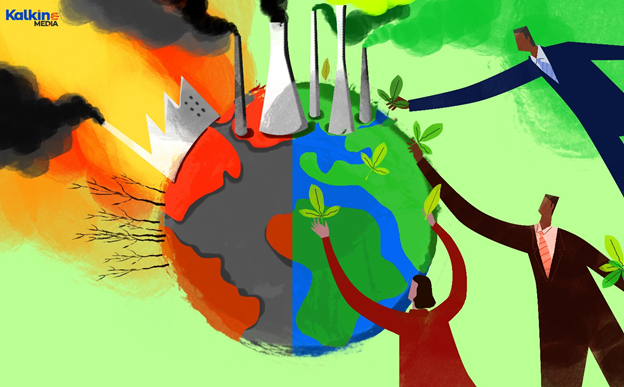
Source: Copyright © 2021 Kalkine Media
Also read: What is greenwashing?
The International Monetary Fund (IMF) proposed a three-tier system in which developed nations will pay US $75 (£56) per tonne of carbon and less developed nations will pay US $50 (£37) and US $25 (£18).
Lord Barker, chairman of Russian aluminium producer EN+, also called for an international price on carbon as coal-fired aluminium often emits about 16 to 18 tonnes of carbon per tonne of aluminium and electric-powered aluminium emits about 2.5 tonnes of carbon per tonne of aluminium. The company is evaluating a method to cut the emissions to about 10 kilograms per tonne.
What is Carbon Tax?
Carbon Tax is a tax levied on the businesses that produces carbon dioxide (CO2) and other harmful gas through their operations. The government sets a price that emitters have to pay for each ton of greenhouse gas emission, which help in reducing the emissions, as the companies will try to avoid the tax. The tax makes it more expensive for companies to use carbon-based fuels and it increases the prices of electricity and gasoline, giving companies a reason to switch to clean energy.
All fossil fuels such as coal, oil, natural gas, and gasoline contain carbon, which releases carbon dioxide when burned which acts as a greenhouse gas. It prevents the infrared radiation has heated earth from escaping to space efficiently that creates a heat-trapping effect. The accumulation of these harmful gases leads to climate change and cause non-reversible harm to the environment.
Taxes on GHGs come are of two types: emission tax, which is based on the quantity an entity produces, and a tax on goods or services that are usually greenhouse gas-intensive, such as a carbon tax on gasoline.
Also read: Carbon conscious: 6 carmakers agree to go green by 2040
Implementing a Carbon Tax
Carbon found in any products that is not burned is not taxed, similarly carbon dioxide that is permanently isolated from production and is not released in the atmosphere are not taxed, but taxed paid when the fuel or gas is extracted from the Earth or during upstream process. Businesses then pass these taxes to customers.
Carbon Taxes in Action
Around 40 nations, governments and regions across the world have imposed carbon tax or tax similar to carbon tax such as energy tax. Around 15% of global greenhouse gas emissions are covered by carbon pricing schemes.
As of 2021, around 35 carbon tax programmes have been implemented across the world. In 2019, South Africa became the first African country to impose carbon tax. The UK has had carbon tax since 2008 and on January 2021, UK Emissions Trading Scheme (EU ETS) replaced the UK’s participation in the EU ETS that is established through the Greenhouse Gas Emissions Trading Scheme Order 2020. In 2006, the city of Boulder became the first US city with a direct voter-approved carbon tax.
The European Union countries partly rely on a market exchange system known as the European Union Emissions Trading Scheme (ETS), where companies are allowed to trade emission rights between each other. Various eastern European countries and Organization for Economic Co-operation and development (OECD) indirectly taxed emissions through taxes on motor vehicles and energy products.
Also read: Nations conclude climate agreement after last-minute compromise on fossil fuels
