
 AUS
AUS
 NZ
NZ
 UK
UK
 CA
CA
 USA
USA
 IND
IND








Summary
- Two back-to-back promising news on the COVID-19 vaccine have built positive sentiment among investors.
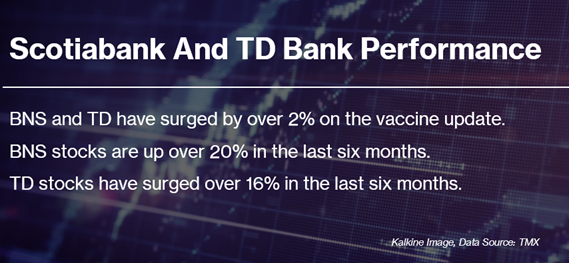
- Bank of Nova Scotia and The Toronto-Dominion Bank stocks have surged by over 2 per cent on the vaccine update.
- BNS stocks are up over 20 per cent in the last six months.
- TD stocks have surged over 16 per cent in the last six months.
Biotech firm Moderna claimed that its vaccine has 94.5 per cent effective in preventing coronavirus, reporting interim data from the ongoing third phase study. This is the second promising news on the COVID-19 vaccine in just two weeks. Last week, pharmaceutical giant Pfizer and biotech firm BioNTech announced their COVID-19 vaccine has 90 per cent efficacy.
On the back of the two positive news on COVID-19 vaccine, bank and financial stocks started trending, emerging among most active stocks due to high trading volume on the Toronto Stock Exchange (TSX). Banks are often considered an indicator of economic growth, and a rise in their stock valuation offers hope of rebound in Canadian economy.
We will take a closer look at the stock performance and financial health of Bank of Nova Scotia (TSX:BNS) and Toronto-Dominion Bank (TSX:TD). Both stocks soared by over 2 per cent on November 16.
Bank of Nova Scotia (TSX:BNS)
Current Stock Price: C$ 55.44
Bank of Nova Scotia is one of the leading banks in Canada, its operations are primarily concentrated in Central and South American markets. The bank has proactively implemented various digital solutions to provide financial assistance to its customers during the COVID-19 pandemic.
In a recent statement, Scotiabank announced its latest Diversity and Inclusion Goals, set to enhance the diversified work culture over the next five years, with an emphasis on people from the black community, native people, minorities, people with disabilities, and women.
The company has planned to double the Indigenous employee representation; mainly increasing the number of employees with disabilities and reinforcing the global number of women in executive ranks.
BNS Stock Performance
BNS stocks are up over 20 per cent in the last six months. The stock price of the lender has increased by nearly 9 per cent in the last three months. The stock has rebounded almost 33 per cent since the COVID-19 caused market crash on March 24.
The bank pays its shareholders quarterly cash dividend of C$ 0.90 per share and holds a current dividend yield of 5.798 per cent. BNS’ three-year dividend growth is 5.54 per cent, and its five-year dividend growth is 5.89 per cent.
The lender’s profit-to-earnings (P/E) ratio is 10.60. The BNS stock delivers a positive return on equity (ROE) of 10.60 per cent and a marginal return on assets of 0.60 per cent. The price-to-book (P/B ratio) is 1.196 and the price-to-cash flow ratio (P/CF) is 1.50, as per data on the TSX.
The blue-chip stock made it to TMX’s Top price performer stocks that have the largest gains on the TSX and TSXV in the last 30 days. Its 10-day average trading volume is 4.76 million units.
BNS Financial Highlights
The bank posted a net income of C$ 1.3 billion in the third quarter of fiscal 2020, as compared to C$ 1.98 billion in Q3 FY19. The company registered diluted earnings per share (EPS) of C$ 1.5 in the latest quarter, down 31 per cent from C$ 1.5 at the same time last year. Return on equity stood at 8.3 per cent in Q3 FY20, compared to 11.5 per cent in Q3 FY19.
BNS’ return on equity dropped to 8.3 per cent, driven by the higher provisions of C$ 2.181 billion for the bad loans this quarter.
Toronto-Dominion Bank (TSX:TD)
Current Stock Price: C$ 66.22
Toronto-Dominion is also among Canadian big six banks, and it runs the following three divisions: Canadian retail banking, U.S. retail banking, and wholesale banking.
The bank was been ranked No.1 for the fourth time in a row for supporting over 1,500 businesses through U.S. Small Business Administration (SBA) loans in its Maine -to- Florida footprint for the fiscal 2020.
TD Stock Performance
TD stocks have surged over 16 per cent in the last six months. The bank stock has increased by nearly 6 per cent in the last three months. It has recovered over 34 per cent since the COVID-19 caused market crash on March 24.
The lender pays its shareholders quarterly cash dividend of C$ 0.79 per share and holds a current dividend yield of 4.772 per cent. TD’s three-year dividend growth is 8.85 per cent, and its five-year dividend growth is 8.98 per cent.
The bank’s profit-to-earnings (P/E) ratio is 12.60. The TD stock offers a positive return on equity (ROE) of 10.75 per cent and a marginal return on assets (ROA) of 0.58 per cent. The price-to-book (P/B ratio) is 1.384, and the price-to-cash flow ratio (P/CF) is 0.60, as per data on the TSX.
The Canadian banking giant has been placed among TMX’s top price performer stocks that have the largest gains on the TSX and TSXV in the last 30 days. TD’s 10-day average trading volume is 6.56 million units.
TD Bank Financial Highlights
TD bank registered diluted earnings per share of C$ 1.21 in the third quarter of 2020, compared to C$ 1.74 in Q3 2019. The bank posted a net income of C$ 2.248 billion in Q3 2020, plunged from C$ 3.2 billion in Q3 2019. TD’s adjusted net income also fell from C$ 3,338 million in Q3 2019 to C$ 2,327 million in Q3 2020.
