
 AUS
AUS
 NZ
NZ
 UK
UK
 CA
CA
 USA
USA
 IND
IND







Prescient Therapeutics Limited (ASX: PTX) is a clinical-stage oncology company focused on developing personalised medicines as potential novel targeted cancer therapies for a range of challenging cancers with significant unmet need. Prescientâs approach is to address the mutations that cause cancer. Prescient is known for having a robust and deep product pipeline with two unique drug candidates, PTX-100 and PTX-200.
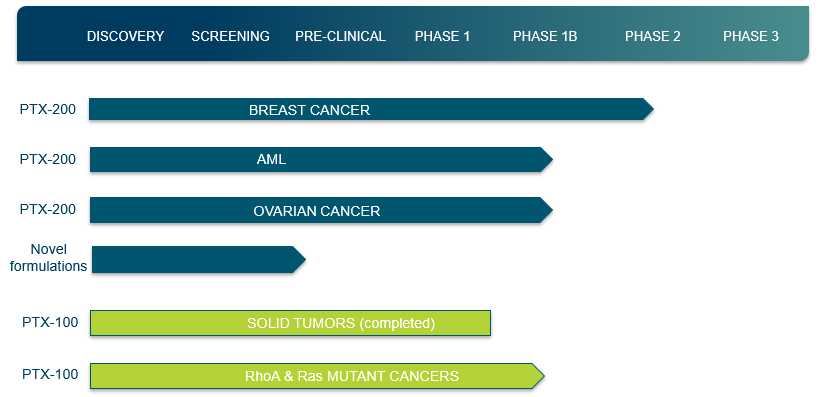 Source: Companyâs Report
Quarterly Update for three months ended 30 September 2019
On 30 October 2019, Prescient Therapeutics released September 2019 Quarterly Updates on its financial results and clinical progress. Key highlights of this quarterly report are as follows-
Prescientâs Financial Developments
With $8.71 million cash reserves, Prescientâs is well-funded, that lays the foundation to continue its research and clinical development activities during the next year. Key Highlights of Prescientâs financial progress are as follows-
- Net cash outflow from operating activities amounted to $950,000.
- Total cash outflows for next quarter is estimated to be $2,600,000 that includes research and development costs of $ 1,185,000, product manufacturing and operating costs of $469,000, staff costs of $518,000, and administration and corporate expenses of $428,000.
- Financial management and cash flow timing resulted in lesser expenditure in the current quarter as compared to the previous quarter.
Prescientâs Clinical Advancements
One of the key milestones Prescient has accomplished during the given period is the commencement of first Phase 1b clinical trial of its unique inhibitor PTX-100.
Mechanism of action of PTX-100 involves disruption of oncogenic Ras pathway downstream via inhibiting the post-translation modification of Rho, Ral, and Rac circuits in cancer cells. Lately, Ras pathway has been the subject of industryâs growing attention. PTX-100 is a first in class compound that blocks a main cancer growth enzyme, geranylgeranyl transferase (GGT), which plays a key role in malignant cell transformation.
It is worth noting that PTX-100 is the only Ras pathway inhibitor in an ASX-listed company. Moreover, to the Companyâs knowledge, Prescientâs PTX-100 is the sole RhoA inhibitor across the globe that is in the clinical development stage.
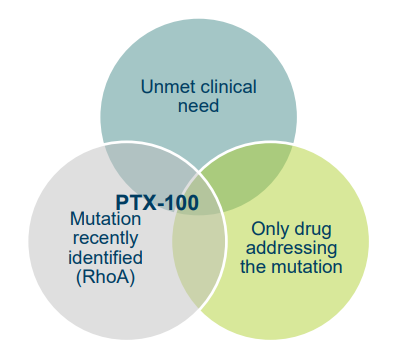
PTX 100 Phase 1b trial âBASKETâ study
The main aim of Phase 1b PTX-100 âbasketâ study is to determine the optimal dose and treatment schedule of PTX-100 in a range of hematological and solid malignancies including myeloma, T-cell lymphomas, pancreatic and gastric cancers with Ras and RhoA mutations. The screening of eligible patients has already been started by a team of clinical investigators headed by globally renowned oncologist, Professor H. Miles Prince AM at Epworth Health in Melbourne.
Contrary to the conventional clinical trials, in BASKET approach, patients are grouped based on the mutational profile of the tumour, rather than the tumour origin and these basket trial bundles recognise patients carrying this mutation and switches it off with a specific targeted therapy.
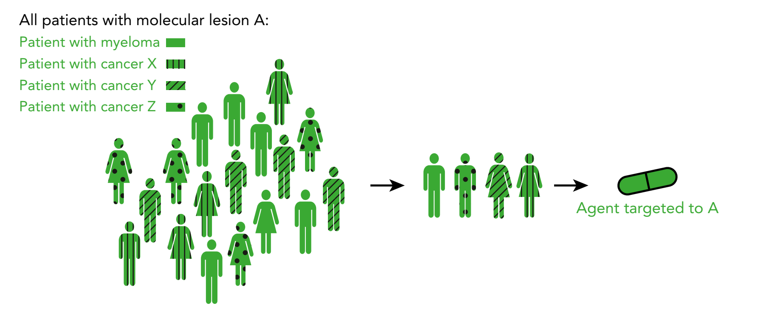 The Basket Approach. Source: Company Presentation
PTX-100 had been found well-tolerated as unveiled by previous Phase 1 trial conducted in advanced solid tumors. Moreover, PTX-100 also achieved stable disease.
Besides, during this quarter, Prescient also continued to work on its another lead drug candidate, PTX-200 trials.
Continued Positive Market Developments
Given the emerging global interest in other Ras inhibitors in development, the Company believes that initiation of phase 1b clinical trial with its novel and unique Ras pathway (and RhoA) inhibitor, PTX-100 is timed appropriately. Though these Ras inhibitors are catching substantial attention within the Ras inhibition space, PTX-100 stands out with its well-differentiated and unique properties amid these competitors.
It has been reported that, during the quarter, an American multinational biopharmaceutical player Amgen gained significant attention at the annual European Society for Medical Oncology (ESMO) meeting held in Barcelona, Spain where it released new data from the Phase 1 study with its new cancer drug AMG-510, a KRAS inhibitor working on the similar principle of Ras inhibitory pathway. This data has provided more encouragement to clinicians and researchers worldwide, although it was not as promising as the data released at the American Society of Clinical Oncology earlier in June.
Amgenâs encouraging progress validates Prescientâs strategy of targeted therapies in the area of personalised medicine and helps show proof of concept paving the way for smaller companies like Prescient taking diverse approaches to this array of challenging oncogenic mutations.
Medical professionals have developed strong interest post these positive, progressive developments, with more studies and data expected to be released in the coming months.
Prescientâs clinical programs are part of the vital developments that are being made in precision oncology which remains on the path to revolutionise the treatment of numerous malignances globally.
With an aim to create significant long-term value for stakeholders, Prescientâs impressive Board and management team with recognised accomplishment in bringing the drug from the bench to the bedsideâ from discovery continue to focus on delivering the clinical milestones and business development activities.
On 06 November 2019, with a market capitalisation of $17.74 million and 394.26 million outstanding shares, PTX was trading at $0.048, up by 6.7% as compared to its previous closing price (AEST: 2:12 PM).
Disclaimer
This website is a service of Kalkine Media Pty. Ltd. A.C.N. 629 651 672. The website has been prepared for informational purposes only and is not intended to be used as a complete source of information on any particular company. The above article is sponsored but NOT a solicitation or recommendation to buy, sell or hold the stock of the company (or companies) under discussion. We are neither licensed nor qualified to provide investment advice through this platform.
