
 AUS
AUS
 NZ
NZ
 UK
UK
 CA
CA
 USA
USA
 IND
IND






Highlights
- The World Health Organization (WHO) states climate change as the greatest threat to global health in the 21st century
- Submitting more ambitious climate targets to the UN gives a formal status to Australia's vow to decrease greenhouse gas emissions
- Australia will be investing AU$20 billion for expediting the decarbonisation of the nation's electricity grid
Climate change refers to long-term changes in temperature and weather patterns. According to the World Health Organization (WHO), it is the greatest threat to global health in the 21st century. Rising sea levels, melting glaciers, heat waves, storms, droughts, etc., are some of the key environmental hazards of climate change.
Australia is a signatory of the Paris Agreement, which came into force in 2016. It builds on ongoing international efforts to deal with climate change under the United Nations Framework Convention on Climate Change (UNFCCC).
Do read: Can UN Bonn meet prompt member nations for accelerated climate response?
Australia's international Climate Change Action Strategy outlines long-term strategic direction over 2020-25. Its key objectives are:
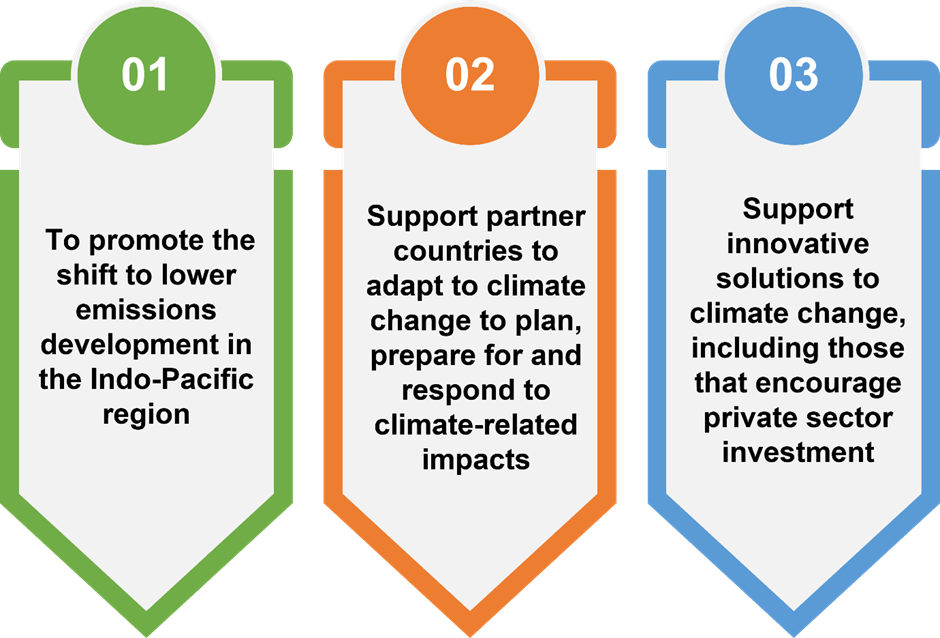
Image source: © 2022 Kalkine Media®
On Thursday, the Australian government released an important press release on climate change. Australian Prime Minister Anthony Albanese and the Minister for Climate Change and Energy Chris Bowen conveyed Australia's updated Nationally Determined Contribution (NDC) under the Paris Agreement to the Executive Secretary of the United Nations Framework Convention on Climate Change (UNFCCC).
The Australian Prime Minister said that upon the resumption of Parliament, the government will move quickly to preserve Australia's 2030 and 2050 targets in legislation, providing the certainty being sought by the industry and investors.
Is Australia on track to achieve net-zero emissions by 2050?
Australia’s submission of updated NDC to UNFCC gives a formal status to the country’s vow to decrease greenhouse gas emissions by 43% below 2005 levels by 2030. It is expected to set Australia on track to achieve net-zero emissions by 2050.
To achieve the targets, the Australian government has set out a comprehensive set of policies. Let us have a look:
Investments
- Expediting decarbonisation of Australia's electricity grid -- AU$20 billion
- Delivering community batteries and solar banks throughout Australia – AU$300 million
- Supporting renewables manufacturing and low emission technologies – Upto AU$3 billion
- Training of 10,000 New Energy Apprentices in the jobs of the future – AU$100 million
- Provide additional training pathways through New Energy Sills Program – AU$10 million
- Doubling the amount of investment in electric vehicle charging and launching hydrogen refuelling infrastructure to AU$500 million
Other important actions:
- Assisting the development of new clean energy industries and the decarbonisation priorities of existing industries by powering the Regions Fund
- Introducing declining emission baselines for Australia's major emitters, under the existing Safeguard Mechanism,
- Implementing Australia's first National Electric Vehicle Strategy to accelerate the uptake of EVs and reduce emissions
- Reducing the emissions of Commonwealth Government agencies to net-zero by 2030