
 AUS
AUS
 NZ
NZ
 UK
UK
 CA
CA
 USA
USA
 IND
IND







Usage of daily broadband increased substantially as level 4 lockdown started at 11:59 pm on 25 March and many people started working from home, and students increased their use of the internet for entertainment and online learning. This company has witnessed an improvement in EBITDA margins from FY 2013 to FY 2020. Also, the company’s stock delivered respectable returns. In the span of 3 months, the stock has witnessed a rise of ~21.57% while, in the time frame of past 6 months, the stock rose ~47.49%.
One company that benefitted from the increased usage of the internet was Chorus Limited.
Chorus Limited (NZX: CNU)
Investment Summary:
- The company witnessed robust growth in fibre uptake, up from 53% to 60% during FY 2020.
- CNU plans to pay a final dividend amounting to 14 cps on October 12, 2020.
- Its NPAT amounted to $52 million as compared to $53 million in FY 2019.
Chorus Limited is the country’s leading telecommunications infrastructure company. It was formed in 2008 as a Telecom business unit to provide all service suppliers access to the local fixed-line network. In December 2011, the company reached a key milestone, officially becoming a separate entity and listing on the NZX.
While improving its EBITDA margins from 63.1% in FY13 to 75.5% in FY20, the company has delivered sustainable growth and registered CAGR of 6.51% in gross profit over the period of FY12-FY20. The company has a strong track record of maintaining its margins. Its gross margin has improved from 63.9% in FY13 to 68.9% in FY20.
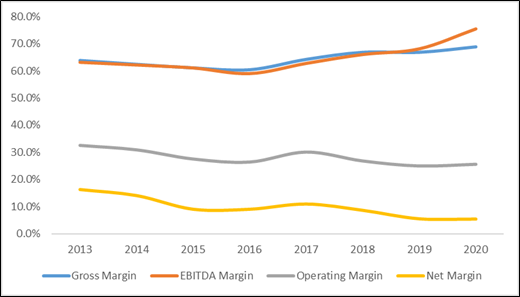
Key Margins (Source: EODHD/Others (Thomson Reuters))
CNU Reports Mixed Set of Results
For the year ended 30 June 2020, the company reported EBITDA of $648 million, an increase of $12 million on the previous year (FY19). NPAT stood at $52 million as compared to $53 million in FY 2019.
The FY20 results reflect positive gains of the continued reduction in network maintenance costs as well as a fall in annual regulatory levies. The company also stated that it would be paying final dividend amounting to 14 cents per share on October 12, 2020.
Monthly average household data usage rose from 265GB to 313GB across the year. Fibre customers averaged 387GB in June, up from 341GB the year before.
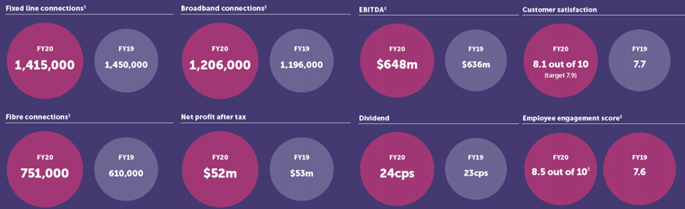
FY20 Result Overview (Source: Company Reports)
Stable Momentum in Data Usage
The combination of continuing growth with respect to online streaming demand as well as COVID-19 driven changes to consumer behaviour saw peak time usage grow over 30% from the year before. That is the equal of more than half a million simultaneous high-definition video streams. Fibre consumers were averaging 387GB per month, in comparison to 198Gb for the copper customers. As per the company’s forecast, average data usage on fibre is likely to surpass 1,000GB a month by 2024.
The growth is anticipated to be driven by the proliferation of 4K television sets, followed by 8K in the coming future, and bandwidth hungry services like online gaming. As demand for data keeps growing, fibre’s ability to offer consistent throughput at the dedicated speeds happens to be a competitive advantage.
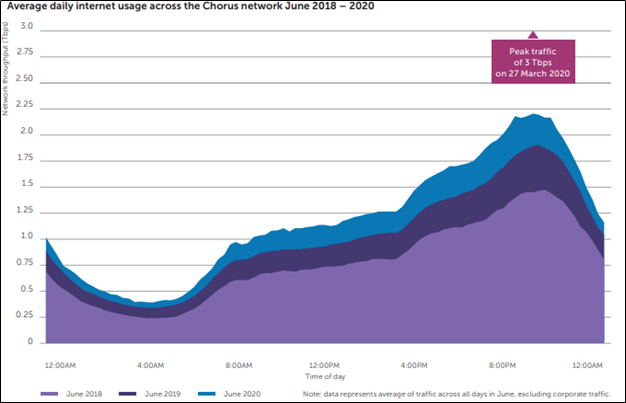
Key Data (Source: Company Reports)
Broadband verified as the 4th utility
The demands placed upon the company’s network due to COVID-19 evidently confirmed broadband’s status as the 4th utility. Broadband traffic grew by ~35 percent during the period of lockdown as New Zealanders were needed to connect as well as work from home. This increase would have been roughly 10% higher if global streaming services like Netflix and YouTube had not restricted the bandwidth requirements of their streaming service.
The figure given below shows the changes in usage patterns from the pre-lockdown period (in blue) to the Alert Level 4 lockdown period (in green), and then began to moderate as restrictions were gradually relaxed through Alert levels 3 and 2, that allowed people to return to work and school.
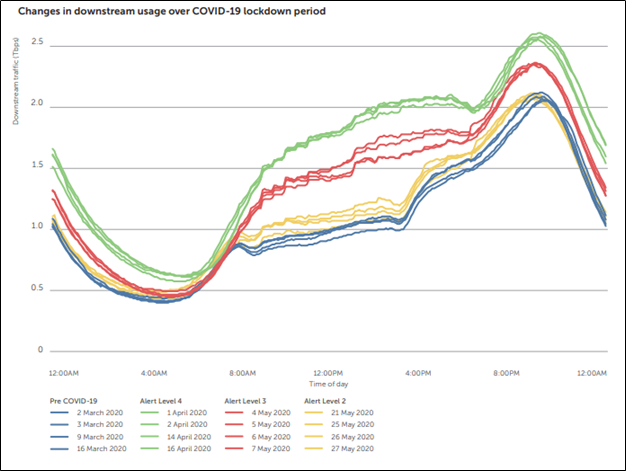
Key Data (Source: Company Reports)
Fibre Deployment Halted due to COVID-19
When the country entered Alert level 4 on 25 March, the company stopped all non-essential build, maintenance, and installation activity. This meant the UFB2 rollout was stopped until the lockdown restrictions began easing from 27 April. Even though broadband was acknowledged as an essential service, the company could only accomplish physical broadband installations in limited circumstances.
The company’s door-to-door fibre migration programme was suspended. There was a slowdown in fibre installations, from an average of 650 daily to ~100 a day. The number of working installation crews fell from around 640 to ~260.
Outlook
For FY21, the company is expecting to report EBITDA of $640 million to $660 million and capital expenditure is expected between $630 million to $670 million. For FY 2021, the company is expecting dividends amounting to 25 cents per share, subject to no significant adverse changes with regards to circumstances or outlook.
Key Risks
In the normal course of business, the company has exposure to several financial risks which include volatility in the electricity prices. CNU has been exposed to liquidity risk.
The stock of CNU ended the session at NZ$9.09 per share, reflecting a rise of 0.33% on September 18, 2020.