
 AUS
AUS
 NZ
NZ
 UK
UK
 CA
CA
 USA
USA
 IND
IND







Highlights
- The Climate Action and Awareness Fund (CAAF) mainly focuses on advancing climate science and technology and supporting youth climate awareness and community-based action
- The Low Carbon Economy Challenge will focus on providing nearly C$ 500 million to various recipients, such as municipalities, provinces and territories, and Indigenous communities
- The Nature Smart Climate Solutions Fund mainly natural solutions for climate change
To support Canada’s climate plan, the government of Canada is providing funds for projects through various grants and contributions programs. In this article, we will learn the role of Environment and Climate Change Canada funding programs in Canada.
Environment and Climate Change Canada (ECCC) funding programs include the below mentioned.
Climate Action and Awareness Fund (CAAF)
To support Canadian-made projects which help in lowering greenhouse gas emissions, the CAAF program will be investing up to C$ 206 million over five years. CAAF gets its funding from the Environmental Damages Fund and the Climate Action Fund programs.
CAAF is mainly focused on advancing climate science and technology and supporting youth climate awareness and community-based action.
Low Carbon Economy Fund (LCEF)
To support projects which help in building resilient communities, developing clean growth, and creating job opportunities for Canadians, LCEF will focus on investing up to C$ 2 billion.
LCEF includes the Low Carbon Economy Leadership Fund and the Low Carbon Economy Challenge.
The Low Carbon Economy Leadership Fund will focus on providing up to C$ 1.4 billion to the provinces and territories that have executed the Pan-Canadian Framework on Clean Growth and Climate Change plan.
The Low Carbon Economy Challenge will focus on providing nearly C$ 500 million to various recipients, such as municipalities, provinces and territories, and Indigenous communities.
Also read: What is Intergovernmental Panel on Climate Change (IPCC)?
Nature Smart Climate Solutions Fund (NSCSF)
To support projects which help in conserving, restoring, and enhancing wetlands, peatlands, and grasslands, NSCSF will be investing up to C$ 631 million over ten years. It consists of three project streams, including the Place-based actions stream, the Sector-based policy stream, and the Reverse auction pilot stream.
NSCSF mainly focuses on reducing net GHG emissions in Canada by using natural climate solutions.
The eligible funding recipients include the following
- Indigenous research, academic and educational institutions
- Canadian individuals
- Domestic or international for-profit organizations
- Local organizations
- Provinces, and territories
- Domestic or international not-for-profit organizations
Also read: How does Canada’s forestry industry tackle climate change?
Environmental Damages Fund (EDF)
The ECCC administered (EDF) focuses on restoring the natural environment and wildlife conservation. The fines which are directed to the EDF are used in providing funds to the projects which focus on restoration, education and awareness, environmental quality improvement, and research and development.
The recipients who are eligible to apply for funding are the following:
- Indigenous organizations
- Universities and academic institutions
- Non-government organizations
- Provincial, territorial, and municipal governments
Atlantic Ecosystems Initiatives (AEI)
AEI provides funds for projects that focus on improving Atlantic Canada’s health, productivity, and sustainability of freshwater ecosystems.
It will provide funds to projects that will focus on increasing ecosystem knowledge and science, enhance decision-making, and take actions for conserving, restoring, and enhancing the health and sustainability of freshwater ecosystems in Atlantic Canada.
The eligible funding recipients include the following:
- Non-governmental organizations
- Research, and academic institutions
- Indigenous governments and organizations
- Coalitions and networks of organizations
Also read: What is Canada's Healthy Environment & Healthy Economy climate plan?
Great Lakes Protection Initiative
To address the most significant environmental issues which impact the Great Lakes’ water quality and ecosystem health in Canada, the government of Canada acts through the Great Lakes Protection Initiative. The government focuses on the following:
- It focuses on involving Indigenous peoples to address Great Lakes issues.
- It focuses on the restoration of the Great Lakes Areas of Concern (AOCs).
- It focuses on lowering the discharge of harmful chemicals.
Salish Sea Marine Emission Reductions Fund
This fund focuses on lowering air pollutants and greenhouse gas emissions from domestic marine vessels or fleets which are conducting its operation in the Salish Sea of Canada.
The applicants who are eligible to apply for funding include the following:
- Canadian or foreign individuals
- Provincial, territorial, municipal, and local governments
- Domestic or international not-for-profit organizations
- Domestic or international for-profit organizations
- Local organizations
Also read: What is the Canadian Environmental Protection Act, 1999?
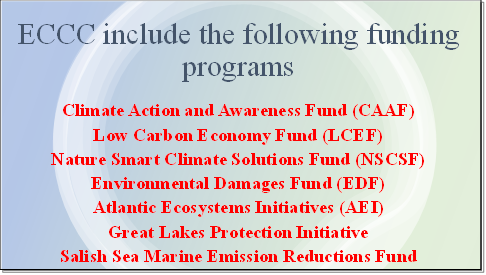
Image credit: © 2022 Kalkine Media®
Bottom line
Through its various funding programs, ECCC is supporting projects that are focused on improving the ecological health of Lake Winnipeg, conserving species at risk, helping reduce greenhouse gas emissions and raising climate change awareness.