
 AUS
AUS
 NZ
NZ
 UK
UK
 CA
CA
 USA
USA
 IND
IND







Highlights
- Canadian stock markets reacted notably to the latest fiscal and economic update released on Tuesday, December 14.
- The update, which comes amid rising inflation and omicron variant cases, noted a projected budget deficit of C$ 144.5 billion for the current fiscal year.
- Ahead of the fiscal update’s release, the S&P/TSX composite index inched lower by 0.1 per cent at 20,731.34 on Tuesday morning.
Canadian stock markets reacted notably to the latest fiscal and economic update released on Tuesday, December 14, which outlined fresh commitments and revisited some previously announced measures.
The update, which comes amid rising inflation and omicron variant cases, noted a projected budget deficit of C$ 144.5 billion for the current fiscal year, as against that of C$ 154.7 billion forecast in Budget 2021.
The shortfall is expected to steadily shrink to C$ 13.1 billion by the fiscal year of 2026-27.
Let’s see how the new fiscal updated impacted Canadian markets.
Also read: Canada Budget 2021: The ‘Record Debt’ COVID-19 Recovery May Bring On
Canadian markets before & after new fiscal update’s release
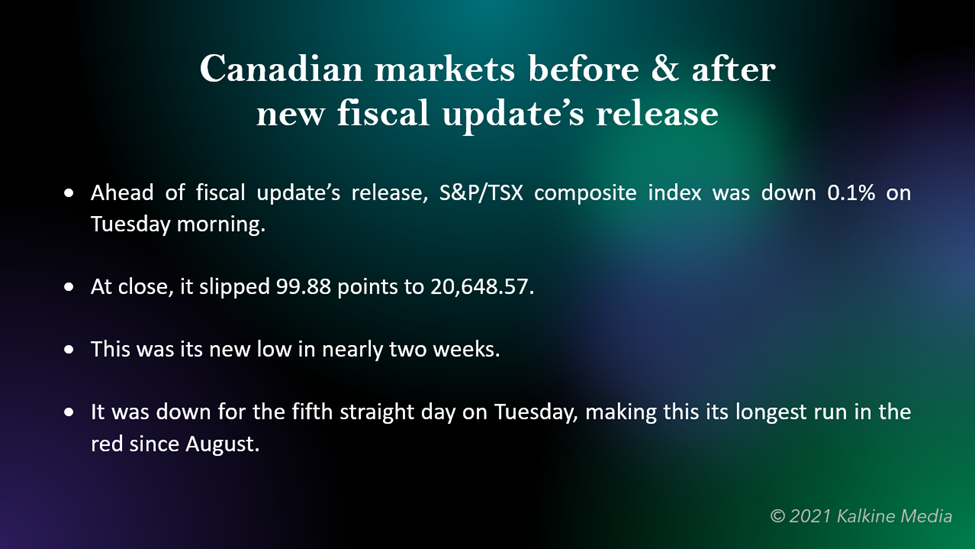
Ahead of the fiscal update’s release, the S&P/TSX composite index inched lower by 0.1 per cent at 20,731.34 on Tuesday morning, pulled down by mining and oil stocks.
At close, the main Canadian stock index slipped by 99.88 points, or five per cent, to 20,648.57, hitting a new low in nearly two weeks. The benchmark index also reached an intraday low of 20,613.67 on Tuesday.
Notably, the S&P/TSX composite index declined for the fifth straight day on Tuesday, making this its longest run in the red since August this year.
The benchmark index’s decline was fueled by pointed falls in the energy sector, which dwindled by 1.6 per cent on Tuesday, and the technology sector, which was down by 1.5 per cent.
The base materials group, on the other hand, lost 0.8 per cent.
While Canadians closely watched the Trudeau government release the new fiscal update, the US saw hotter-than-expected producer prices for November, noting a record 9.6 per cent year-over-year (YoY) surge in wholesale prices.
The rising inflation has been stoking anticipations around central banks speeding up the withdrawal process of monetary stimulus for a while now.
Bottomline
The Canadian government’s new fiscal and economic update has projected a gross domestic product (GDP) growth of 4.6 per cent for this fiscal year, as against that of 5.8 per cent predicted in Budget 2021.
Also read: Canada Budget 2021 Analyzed: How Freeland Invoked Keynes?
The update also forecast economic output to rise by 4.2 per cent in 2022 and by 2.8 per cent in 2023, both of which were an upgrade on the predictions made in Budget 2021.
Further, the Liberal government revised its assumed trading price for the West Texas Intermediate to US$ 68 per barrel for this year and US$ 73 per barrel for next year.
All these updates are likely to impact Canadian stock markets in the near future.