
 AUS
AUS
 NZ
NZ
 UK
UK
 CA
CA
 USA
USA
 IND
IND







Summary
- The UK is planning to introduce a lower carbon emitting petrol called the E10 in September, replacing the current standard fuel the E5.
- E10 has 10 per cent of renewable ethanol, and the rest is unleaded petrol
- It is expected to reduce net emissions by 750,000 tonnes per year
- While the E10 petrol is compatible with 95 per cent of cars on the road, about 1 million cars are estimated are not compatible with the fuel.
The UK is set to introduce a new type of petrol called E10 in September and this will become the new standard petrol for road transportation vehicles across the country. The E10 fuel will replace the existing E5 version, which is the current standard fuel in the UK.
What is E10?
E10 has 10 per cent of renewable ethanol and 90 per cent of regular unleaded petrol in its petrol mix. The fuel is expected to reduce carbon dioxide emissions and is a measure taken by the government to help meet its ambitions net zero targets.
The E10 petrol is expected to reduce transport carbon emissions by up to 750,000 tonnes per year, which is equal to almost 350,000 fossil fuel fired vehicles being taken off the road.
The E5 will continue to be sold across petrol stations but will be classified as super grade instead of premium grade, indicating it will be available at a higher price.
Compatibility challenges
Although, about 95 per cent of cars are currently compatible with the new fuel. About 1 million cars in the UK are not compatible with the new fuel. All cars made since 2011 are compatible. Some car models which may not be compatible include classic cars, mopeds and others.
According to the British roadside automotive assistance company RAC, there are approximately 32.7 million cars in the UK, of which about 18.7 million use petrol as a fuel source.
According to a media report, all cars sold in the EU by legacy carmaker Ford, since 1992 can operate on the new E10 petrol. Moreover, almost all of French automaker Renault’s cars sold since 1997, are also compatible with the new fuel, barring a few models.
Also Read: Will a ban on petrol & diesel car sales help in the UK’s green recovery?
Here are 2 FTSE listed stocks in the automotive sector, let us see how they have reacted to the news:
- Aston Martin Lagonda Global Holdings PLC (LON: AML)
FTSE 250 index constituent Aston Martin is a British independent luxury car company. The company announced on Wednesday that it was suing its Swiss dealer Nebula Project AG over not receiving monetary compensation for its Valkyrie, Valhalla and Vanquish car models.
AML added it would lose up to US $21 million by ending the partnership with Nebula.
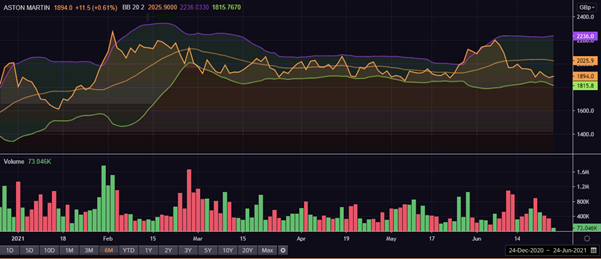
(Image Source: EODHD/Others)
Aston Martin’s shares were trading at GBX 1,891.00, up by 0.45 per cent, on 24 June at 13:18 HRS GMT+1. Meanwhile, the FTSE 250 index was trading at 22,563.95, down by 0.42 per cent.
AML’s market cap was at £2.163 billion, while its annual returns were at 36.73 per cent.
- Renault SA (LON:0NQF)
In addition to being mostly compatible with the newly introduced E10 petrol, French based car company Renault’s also announced recently that its electric vehicle, the Renault Zoe E-tech reached up to 475.4 miles in a single charge.
This distance was almost double the official range stated by the company earlier and was achieved by mission motorsport drivers. The Zoe model battery took over 24 hours to deplete completely and had an average speed of 19 miles per hour.
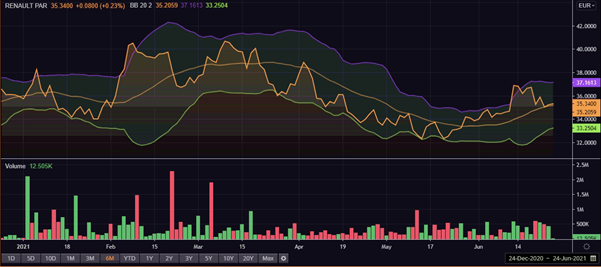
(Image Source: EODHD/Others)
Renault’s shares were trading at EUR 35.43, up by 0.36 per cent, on 24 June at 13:50 HRS GMT+1. Meanwhile, the automotive sector index was trading at 4,761.13, down by 0.29 per cent. Renault’s annual returns were at 58.46 per cent.
Also Read: What Is the UK Doing About the Climate Challenge?
