
 AUS
AUS
 NZ
NZ
 UK
UK
 CA
CA
 USA
USA
 IND
IND







Highlights
- Theralase® Technologies has completed Phase II patient enrollment as per the bladder cancer study plan.
- A total of 90 patients have been enrolled, with 78 completing all scheduled assessments.
- Interim results show a 64.4% complete response rate and 73.6% total response, exceeding International Bladder Cancer Group benchmarks.
- Long-term follow-up indicates durable responses, with CR rates of 21.3% at two and three years and 2.1% at seven years.
- Full clinical data will be compiled in 2026 for submission to Health Canada and the U.S. FDA, targeting regulatory approval in 2027.
Theralase® Technologies Inc. (TSXV:TLT) (OTCQB:TLTFF) has attracted significant investor interest after its shares surged roughly 25% over five days and more than 62% over the past month, following fresh updates from its Phase II bladder cancer study.
Recently, the clinical-stage pharmaceutical company, focused on the development of energy-activated small-molecule therapies, outlined a detailed progress update on patient enrollment and study milestones, giving the market insight into ongoing clinical developments.
Scale of Clinical Need
Bladder cancer represents a significant disease burden in the United States, ranking as the sixth most commonly diagnosed cancer overall and the fourth most common among men. As cited by the company, current estimates project approximately 84,870 new bladder cancer cases in the U.S. in 2025, with roughly 75% presenting as non-muscle invasive bladder cancer (NMIBC). High-risk NMIBC patients who fail standard-of-care Bacillus Calmette-Guérin (BCG) therapy currently face radical cystectomy as the primary remaining option. This underscores the urgent need for alternative, effective therapies.
Study Progress Snapshot
The company reported that 90 patients have now been enrolled and treated under the Theralase® study protocol, meeting the enrollment target set out in the statistical analysis plan.
Of these, 78 patients have completed all scheduled study assessments and were evaluated at all scheduled assessment visits or were withdrawn early by the principal investigator due to lack of response, while 12 patients remain in follow-up and are pending study completion.
Clinical Outcomes
Interim results demonstrate promising efficacy and safety: 64.4% of patients achieved a complete response (CR) at any point in time, with total response—including complete and indeterminate responses—reaching 73.6%. Indeterminate responses are defined as negative cystoscopy with positive or suspicious urine cytology, indicating potential cancer presence elsewhere in the urinary system.
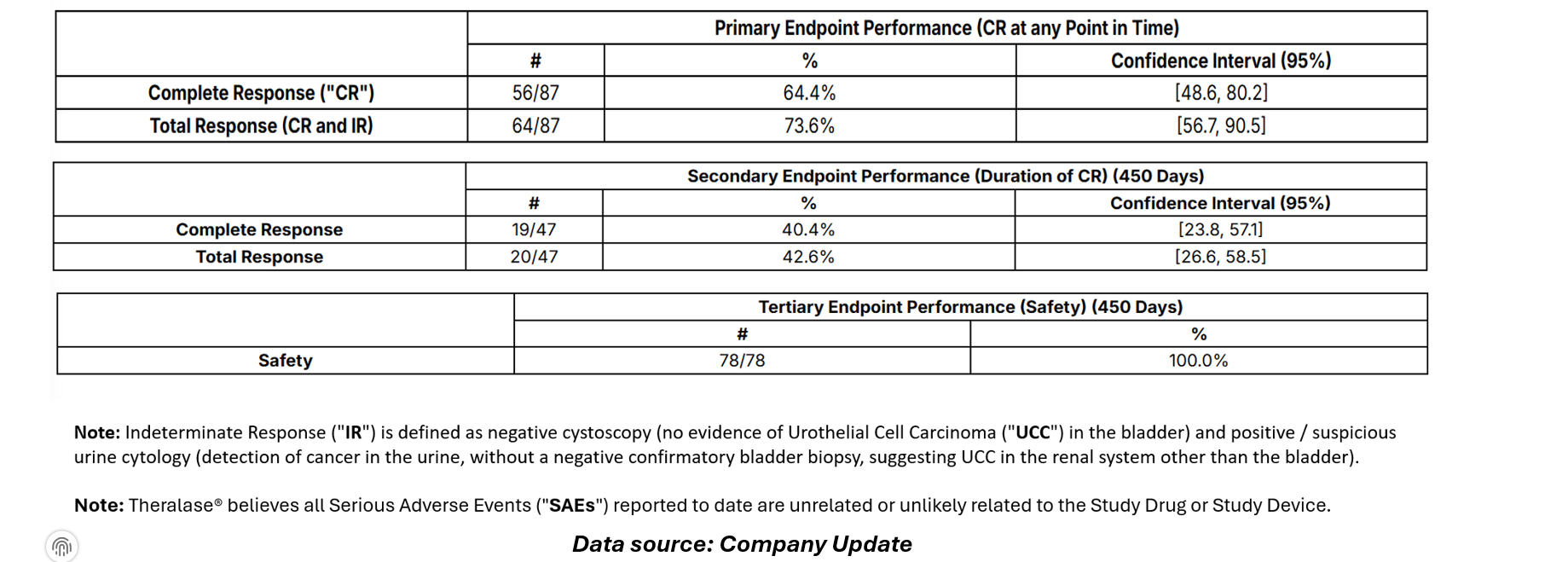
These results are above the International Bladder Cancer Group’s benchmark thresholds, which define clinically meaningful initial complete response rates for carcinoma in situ as at least 50% at six months and 30% at twelve months.
Interim analysis from a subset of 47 patients shows that complete responses were maintained in 21.3% of patients at both the two-year and three-year marks, with a remaining 2.1% observed at seven years.
The therapy’s safety profile is compelling, with all 78 patients monitored for 450 days reporting no serious adverse events attributable to the study drug or device.
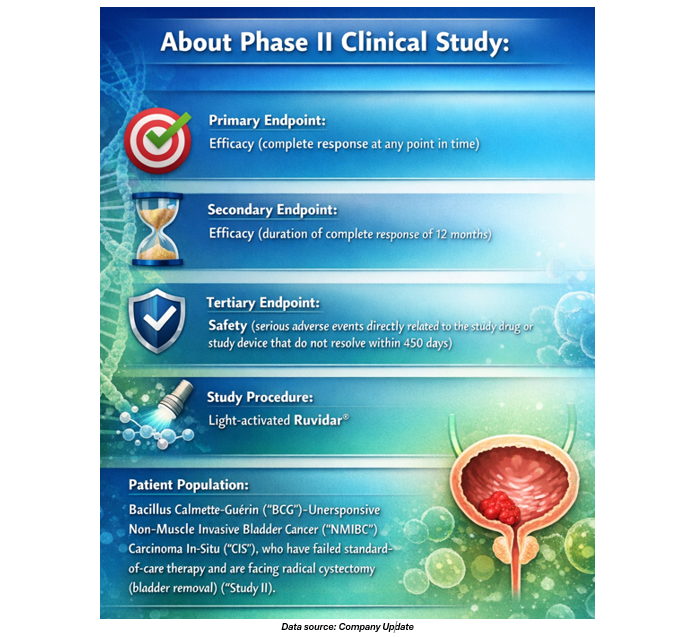
Ruvidar® is an energy-activated small molecule designed to selectively destroy cancer cells while sparing healthy tissue. This targeted, minimally invasive approach could provide patients who fail BCG therapy a meaningful alternative to radical surgery.
Market Potential and Investor Focus
With limited treatment options for BCG-unresponsive NMIBC, the potential commercial market for Ruvidar® is substantial. Investors and the medical community will be closely watching Theralase® as it consolidates the full clinical dataset in 2026, with planned submissions to Health Canada and the U.S. FDA.
Key upcoming milestones in 2026 include regulatory filings, presentations at medical conferences, and further evaluation of long-term response durability, with potential approval targeted for 2027.
TLT last traded at CAD 0.32, up ~8% on February 05, 2026.
